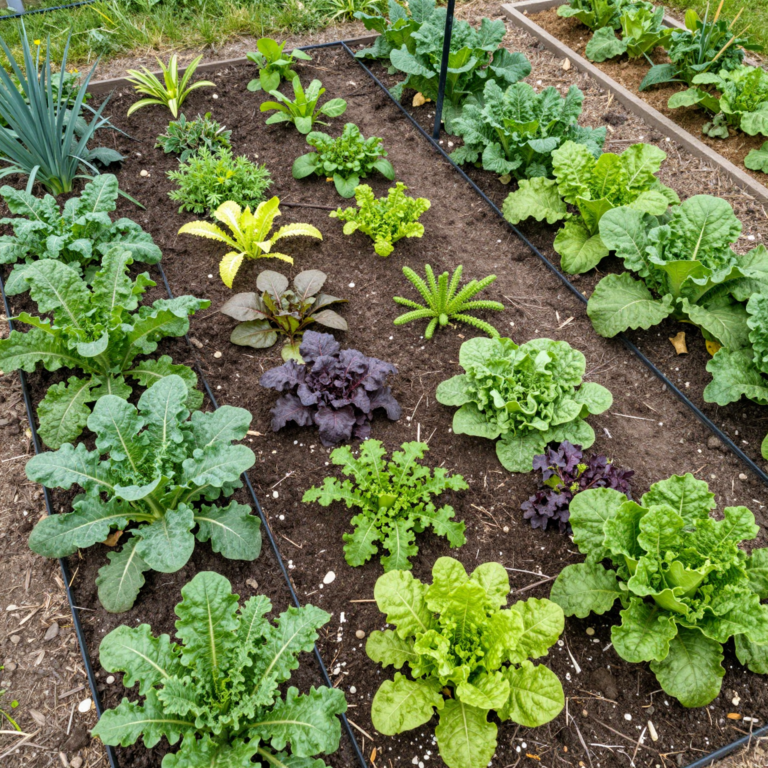

A simple companion planting chart can turn guesswork into a garden plan that just makes sense. When I use one, my beds look more intentional, pests feel less random, and I learn faster with every season.
Companion planting is one of those gardening ideas that sounds fancy, but a chart makes it practical. It helps me pair vegetables and herbs that can support each other—sometimes by attracting helpful insects, sometimes by confusing or deterring pests, and sometimes by improving how plants share space. It also helps me avoid “bad neighbors” that don’t play well together. If you’re growing a backyard garden, a few raised beds, or even containers, this approach gives you clear layout rules you can follow quickly.
If you want an easy way to plan what goes next to what, grab a simple chart and let’s make your garden layout feel effortless.
Key Takeaways
- A simple companion planting chart helps you decide what to plant next to a specific crop (“target plant”).
- Compatible neighbors can support pest control, attract beneficial insects, improve growth, or help with resource use (like trellising or nitrogen).
- Incompatible (“bad”) combinations should be kept from being directly adjacent, even if both can be grown elsewhere in the same garden.
- The best results come from using the chart as a placement guide, not a rigid rule for everything in your garden.
- Start small: build a mini-chart with 5–10 crops you actually grow, then adjust based on what happens in your beds.
Quick Answer
To use a simple companion planting chart: pick a crop you want to grow (your target). Look up its compatible companions and place them next to it. Then check the chart’s “bad/incompatible” list and don’t plant those crops right beside it—keep them in another part of your garden if you want them at all. Repeat for the other crops you plan to grow, and you’ll end up with a workable bed layout.
What You Need
| Item | Purpose | Notes |
|---|---|---|
| A simple companion planting chart (from a guide or PDF) | Provides compatible and incompatible pairings | Look for charts that list “companions” and “incompatible/bad combinations” |
| Pencil and paper (or a notes app) | Lets you plan your layout clearly | I like writing bed rows as boxes |
| Your crop list for the season | Keeps your chart relevant to what you’ll actually grow | Choose 5–10 crops to start |
| Bed map (measuring tape + sketch) | Helps you place plants “adjacent” correctly | Adjacency matters for incompatible pairs |
| A planting schedule (optional) | Helps you coordinate timing | Some companions work best when crops overlap in the right weeks |
| Seeds/starts + labels | Makes your plan real in the soil | Label early so you don’t lose track of what’s where |
| (Optional) Garden twine/markers | Keeps placement from getting messy | Super helpful in smaller beds |
Step 1: Understand What “Companion” Really Means

When I say “companion planting,” I’m not just talking about putting random plants together because they look nice. A companion planting chart is built around the idea that certain plants can help each other.
Most chart-style companion guides focus on pairings where benefits may include:
- Better pest management (by repelling pests or disrupting them)
- Attracting beneficial insects (like insects that help control aphids or other pests)
- Providing support in the garden (like trellising)
- Improving growth through nutrient sharing (common with legumes)
- Potentially improving flavors (some charts mention this as a possible outcome)
The key is that the chart is a planning tool. It’s telling me what to place near each other and what to keep separated.
Step 2: Pick Your “Target Plant” First

Instead of starting with “What can I plant?” I start with the plant that matters most for that bed—my target plant.
For example, if I’m growing carrots, I look up “carrots” on the chart. If I’m growing corn or onions, I look those up instead. This makes the whole process simpler: one target crop gives me a list of neighbors that are more likely to work well beside it.
This is also why a chart is so useful. It turns planting advice into quick layout decisions.
Step 3: Add the Compatible Companions Next to It

On the chart, I find the “companion plants” for my target. Those are the plants that are generally considered beneficial to grow nearby.
I like to think of this as my “allowed neighbors” list. If the chart says carrots have good companions like beans, lettuce, onions, peas, peppers, and tomatoes, I’ll plan some of those next to my carrot section.
Some companion guides also include “why” notes (like rosemary deters carrot flies or dill and chives can improve flavor). Even if your chart doesn’t give a detailed reason every time, the pairing still helps.
Step 4: Check the “Bad/Incompatible” List and Keep Distance
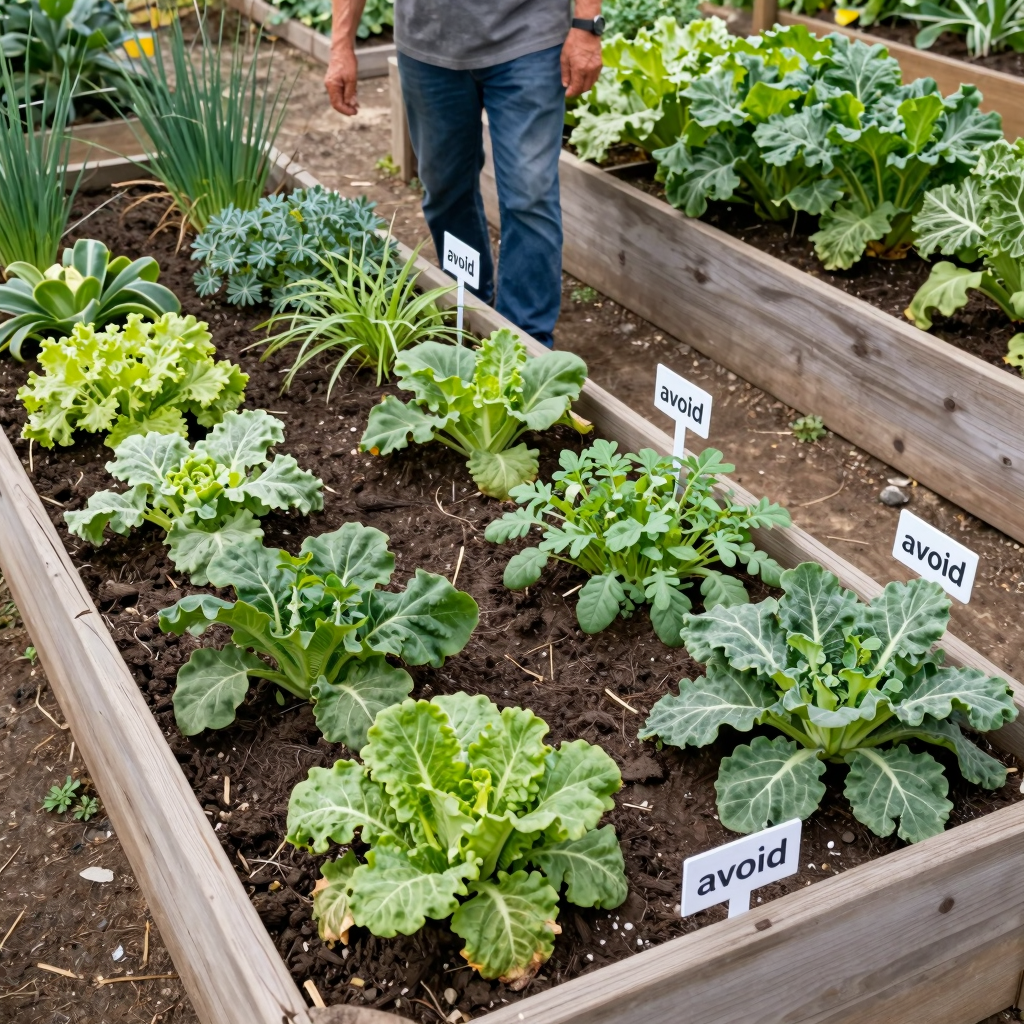
This is the part people skip, and it’s a big reason charts work.
Many companion charts explicitly call out incompatible crops—plants you should not put directly next to the target plant. The logic is simple: even if two plants grow in the same garden overall, they may compete poorly, share pests, or otherwise cause trouble when placed side-by-side.
So when I see a “bad combination” in the chart, I treat it like a spacing rule:
- Don’t place the incompatible crop adjacent to the target crop.
- If I still want to grow it, I keep it in another area of the garden.
Some charts even suggest that incompatible plants can still be grown elsewhere in the same garden—it’s the direct neighbor relationship that the chart is warning about.
Step 5: Look for the “Why”—Choose Companions by Benefit
A simple chart becomes even more powerful when I don’t just memorize pairings—I pay attention to the type of benefit.
Here are common benefit categories I look for when reading charts:
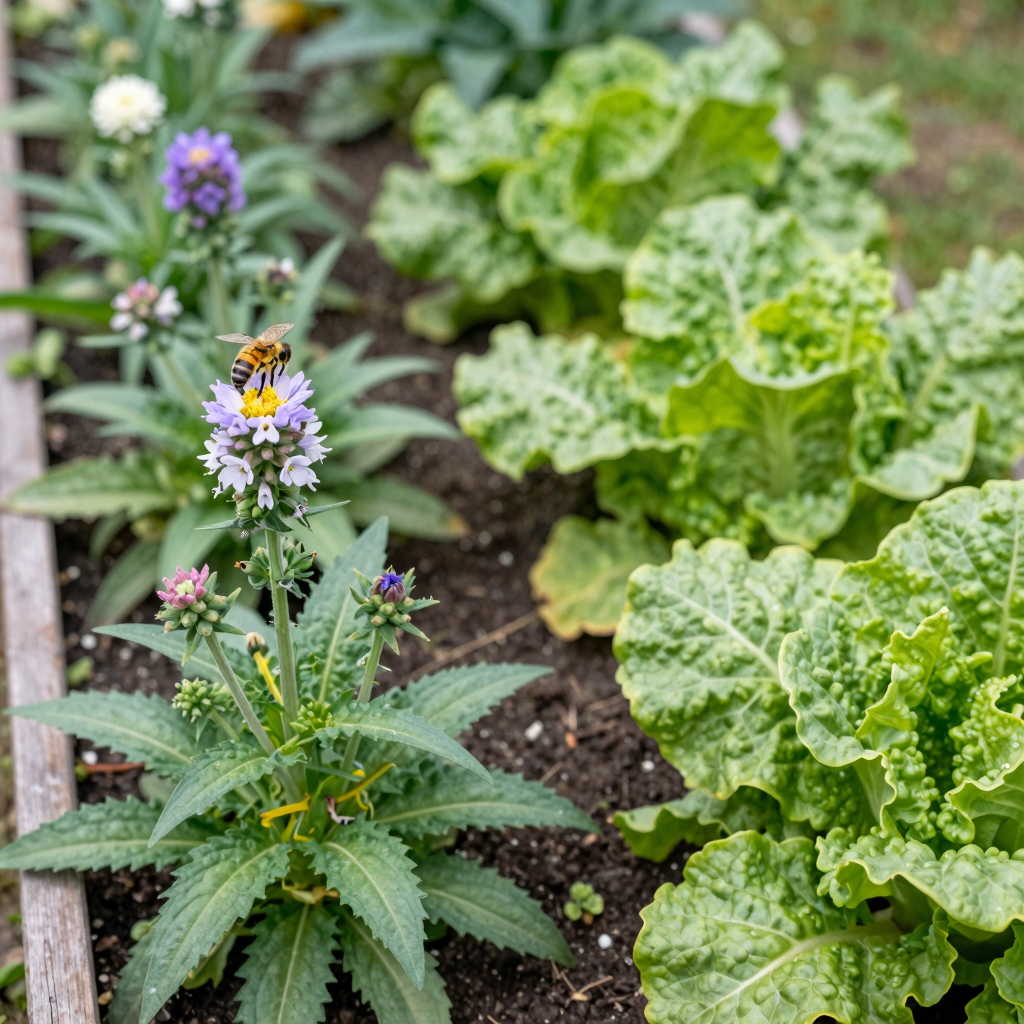
- Attract beneficial insects: Some plants can pull in insects that prey on pest insects. For example, charts may mention plants that attract parasitoid wasps that help control aphids or beetles.
- Pest deterrence: Herbs with strong smells or specific compounds can help keep pests away. Rosemary is one example mentioned in many guides for helping deter carrot flies.
- Trap cropping: Some plants are planted to draw pests away from the main crop. This can reduce damage on the crop I care about most.
- Trellising and space support: Tall plants or vining plants can act like living supports. Corn is often used as a trellis option for climbing beans (especially with certain bean types).
- Nutrient benefits (nitrogen support): Legumes like beans and peas often contribute nitrogen to the soil, which can help other plants nearby grow better.
When I choose companions based on benefit, my garden feels less like random pairings and more like a system.
Step 6: Use Quick Examples to Build Real Layout Habits
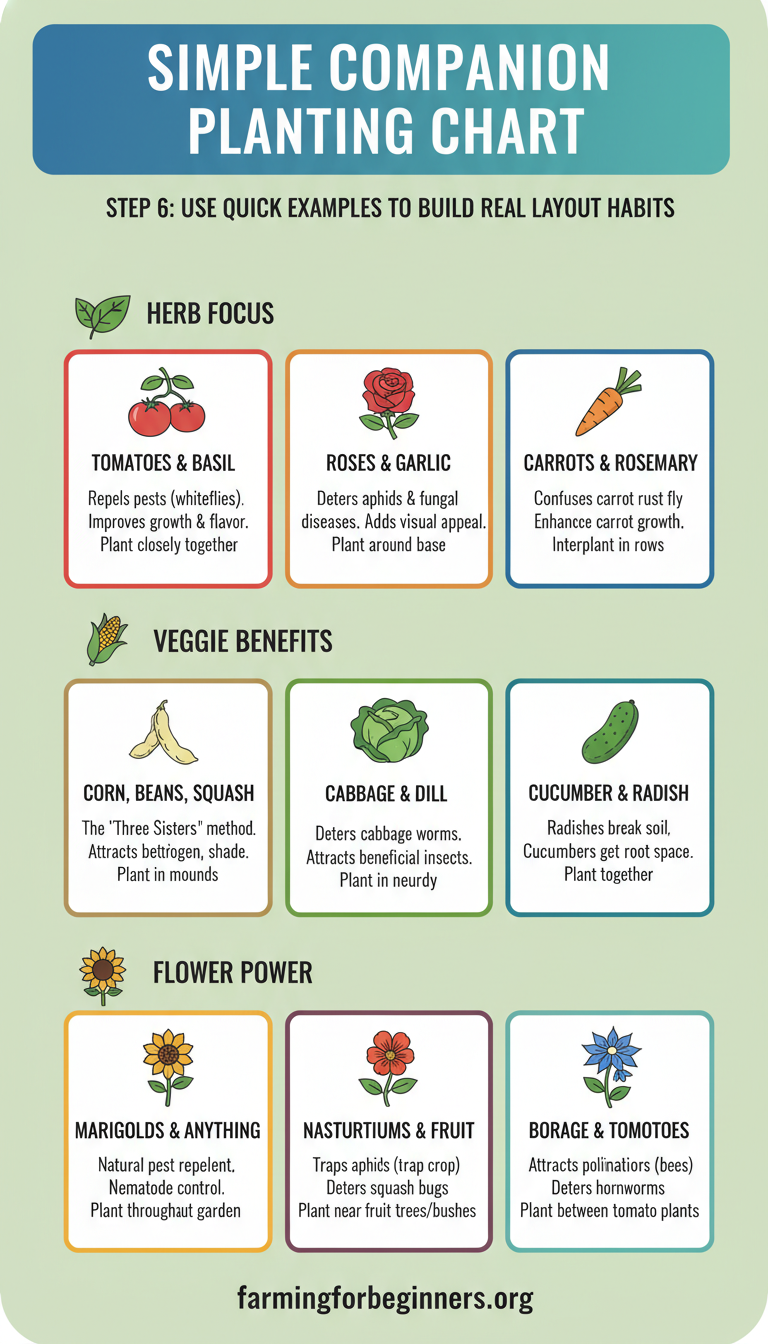
I find it easier to plan when I see how charts behave in real life. Here are a few example-style patterns that show how I use a chart.
Carrots: flavor helpers + pest deterrence
When I look at carrots in common companion charts, I often see a range of compatible neighbors (like beans, lettuce, onions, peas, peppers, and tomatoes). Some charts also mention herbs such as dill and chives improving flavor, while rosemary may deter carrot flies.
My layout habit: I plant carrots in a block, then mix in a few of those neighbors along the edges—especially herbs that help with pest deterrence.
Corn: growth support + watch for pest-sharing notes
Corn companion lists commonly include several neighbors like beans, cucumber, marjoram, peas, pumpkins, squash, and sunflowers. Some guides even note that certain plants may attract shared pests—so I pay attention to the chart’s “benefit vs caution” notes.

My layout habit: I add companions that support growth or space use (like legumes), but I’m careful not to ignore any caution about shared pests.
Onions: broad compatibility across leafy and fruiting plants
Charts often list onions as compatible with many crops such as cabbage, carrots, chard, lettuce, peppers, and tomatoes. Then you might see certain plants grouped as incompatible.
My layout habit: I treat onions like a “buffer” crop. I place them so they are close to compatible plants, but I keep incompatible ones in a different zone.
Beans: trellis + insect help + trap crop ideas
For beans, charts may suggest companions that provide trellising (corn for climbing beans), attract beneficial insects, or act as trap crops (nasty pests get lured away).
My layout habit: If my beans are climbing, I plan for real support. I also mix in a companion plant category that helps with pests rather than only choosing based on looks.
These examples help me think in terms of chart categories, not just plant names.
Step 7: Build Your Own “Simple Chart” (Mini Version)

Once I use a chart a couple times, I stop looking it up constantly. Instead, I build my own simple companion chart based on what I grow.
Here’s the way I do it so it stays easy:
- Choose 5–10 crops you grow most often.
- For each crop, write:
– Compatible neighbors you’d like nearby – Incompatible neighbors to avoid directly next to it – The “why” category (pest deterrence, insect attraction, trellising, nitrogen, etc.)
- Add one placement rule at the top, like:
– “Compatible = plant adjacent” – “Incompatible = keep separated; can be grown elsewhere”
This is how you turn a big chart into a chart you’ll actually use every season.
Step 8: Make a Bed Map and Place Companions Correctly

Now that I know my companions, I need placement.
I sketch my garden into simple sections (rows, blocks, or bed compartments). Then I:
- Place the target crop first
- Add compatible companions in the empty spaces right next to it
- Leave separation space for “bad/incompatible” crops
Two practical reminders I always follow:
- Adjacency matters for incompatible pairs. If the chart says “don’t plant next to,” I take that seriously.
- Spacing still matters. Charts don’t replace normal plant spacing rules. If two plants are compatible but they crowd each other, they can still struggle.
This is where a chart becomes a plan instead of a list.
Step 9: Re-check After You Fill the Bed (One Quick Pass)

When the bed is mostly planted, I do a fast check:
- Did I accidentally place an incompatible crop right next to a target?
- Did I pair the target with at least one or two good companions (not necessarily every listed one, just some)?
- Are my tall trellis plants supporting the right vines?
- Am I still allowing room for normal growth?
That last pass saves me from layout mistakes that happen when you’re moving fast.
Tips

- Start small with a mini-chart. If you try to chart every possible crop on day one, you’ll get overwhelmed.
- Use charts as layout constraints, not guarantees. Your soil, weather, and pests still matter.
- Mix herb companions intentionally. Herbs like rosemary, dill, basil-type herbs, or chives (depending on your chart) can be easy wins for pest deterrence or beneficial insect attraction.
- Separate “bad combinations,” don’t stress about everything else. Keeping direct neighbors apart is usually the biggest chart takeaway.
- Track what happens. I keep quick notes like “aphids stayed lower near X” or “leaf disease spread faster near Y.” Next year, my chart gets smarter.
- Rotate crops when possible. Companion planting helps day-to-day neighbor choices, while rotation helps longer-term soil health.
FAQ
Is a companion planting chart guaranteed to work?
No. A chart is a guide based on common observations and gardening research patterns. Your local climate, soil, and pest pressure can change results. I treat the chart like a planning tool that improves my odds, not a promise.
Do I have to plant every recommended companion next to the target?
Not always. In practice, I usually pick 1–3 companions that fit my bed space and needs. The goal is better neighbor relationships, not perfect coverage.
What does “incompatible” mean—can I still grow them in the same garden?
Usually, “incompatible” means don’t plant directly next to the target crop. Many chart sources treat it as a adjacency issue: you can often grow both crops elsewhere in the same garden, just not side-by-side.
What if I only have one small bed?
Then I focus on the most important pairings. I choose a primary crop for that bed (my target plant), add a couple compatible neighbors, and keep any incompatible crops in containers or a different section if I can.
Can companion planting help with pests?
Often, yes—especially when the chart suggests deterrents, trap crops, or insect-attracting companions. For example, some guides mention herbs like rosemary deterring pests such as carrot flies.
How do I know which companions to choose if there are many?
I choose based on the “why” category:
- Need pest help? Choose deterrent or trap-crop companions.
- Need support/space? Choose trellis companions.
- Need soil boost? Choose legumes nearby.
Conclusion
A simple companion planting chart is one of the quickest ways I can plan my garden with confidence. The method is straightforward: choose a target crop, place compatible companions next to it, and avoid incompatible crops as direct neighbors. Then I make it even easier by building my own mini-chart for the 5–10 crops I grow most.
If you want the best results, start small this season. Use a simple chart, draw a quick bed map, plant confidently, and then adjust next year based on what you observe. That’s how companion planting becomes not just a tip, but a habit that actually improves your garden.

Samuel Michael
I've have been involved in Backyard Farm for over 15 years, especially livestock and market gardening. I blog at my free Time and ive My most helpful thoughts on this blog.