

How to Get Rid of Wasps home and outside
If wasps have found your space, you want them gone fast—without getting stung in the process. When you understand what draws them in (food, light, and entry points) and use the right method for where they are, removal becomes much more manageable. This guide walks you through quick knockdown for wasps you see indoors, nest-focused control outside, and the “finish work” that helps stop them from coming back. You’ll get practical, step-by-step options you can do safely, plus clear signs of when it’s time to call a pro.
Key Takeaways
- Indoors: use a household spray to knock down individual wasps, then remove them from your living space safely.
- Outside: focus on the nest. For ground nests, insecticidal dust applied at the opening can spread into the nest core as wasps carry it in.
- Always reduce sting risk first: plan timing, exits, and how you’ll block access points after treatment.
- After removing or treating a nest, clean the nesting site to remove lingering attractants, such as pheromone traces.
- Prevention matters: seal gaps, reduce food attractants, and consider simple scent deterrents.
Quick Answer
To get rid of wasps at home and outside, knock down the ones inside using a household spray, carefully remove them, then address the nest outside. For ground nests, apply insecticidal dust directly to the nest opening so wasps carry it into the colony. After treatment, block the entry point and clean the site (for example with white vinegar) to help prevent return.
What You Need
| Item | Purpose | Notes |
|---|---|---|
| Household wasp or insect spray (or a household spray like hairspray or bathroom cleaner used for knockdown) | Knock down wasps you see indoors | According to Kitchen Stewardship, coating a wasp can immobilize or kill it because wasps are affected when their exoskeleton is coated. |
| Protective clothing (long sleeves, long pants) | Reduce sting risk | Wear something you can fully cover, especially gloves and sturdy shoes. |
| Flashlight (optional) | Spot wasps and plan exits | Helps you see where they’re moving without lingering near them. |
| Trash bag or container + paper/cardboard | Safely remove knockdown wasps | Avoid handling directly. Dispose right away. |
| Ladder (only if needed) | Access to exterior entry points | Use only if you can do it safely; otherwise, call a professional. |
| Insecticidal dust (for ground nest openings) | Treat nests at the source | Research from Michigan State University Extension explains dust can be carried into the nest by wasps. |
| White vinegar + cloth or paper towels | Clean nesting site after treatment | A reddit pest-control thread suggests cleaning with white vinegar to remove pheromone traces left behind. |
| Sealant or physical blocker (for access holes) | Prevent re-entry and re-nesting | Research context includes blocking an access hole after treatment (example: blocking an entry in a loft/fascia). |
Step 1: Confirm where the problem is—inside wasps vs. outside nests

Start by asking a simple question: are you dealing with wasps you can see inside, or an active nest outside that’s sending foragers in?
How to tell fast
- Wasps inside usually means one or more individuals got in through an opening, and you’re seeing them roam toward light and openings.
- Wasps outside with repeated sightings usually means a nearby nest. You’ll often notice consistent traffic: wasps flying in and out of a specific spot, especially during warm parts of the day.
Why location changes the plan
Control methods are different:
- Indoors is usually about knockdown + safe removal of individual wasps.
- Outdoors is about treating the nest opening or blocking access, plus follow-up cleanup to reduce return.
Step 2: Reduce sting risk before you treat anything

Before you spray, climb, or block access points, set yourself up to avoid panic.
Use timing and calm movement
Michigan State University Extension notes that early morning is the preferred treatment time for wasp control when you’re treating nest openings, which also helps keep activity more manageable. Plan to move slowly and avoid sudden swatting, because provoking them can raise sting risk.
Plan your exit route
- Identify where the wasp(s) will move if you knock them down.
- If you can safely guide a knocked-down wasp toward an exit point (like a window), do it carefully. Kitchen Stewardship describes that you can try to throw knocked wasps out of a window, but it can be unreliable and you may still miss some.
Know when you shouldn’t DIY
If the nest is:
- High up in a hard-to-reach loft or eaves
- Near a place you can’t safely control (like an occupied room)
- Large, heavily active, or you can’t clearly block the access point afterward
…your best move is to call a professional.
Step 3: Get rid of wasps inside with “knockdown then remove”

When a wasp is inside, you want a quick, controlled approach—because chasing them increases the odds of accidental stings.
Use a household spray to coat and knock down individual wasps
According to Kitchen Stewardship, if wasps are in the house, you can use a household spray to knock them down or kill them by coating their bodies. The reasoning given is that wasps can be affected when their exoskeleton is coated, and repeated coating can be enough to knock them down.
Common household sprays people mention include:
- Cooking spray (like Pam)
- Hairspray
- Bathroom cleaner sprays
Kitchen Stewardship also notes this approach may not always work perfectly, but repeated knockdown attempts can reduce the number of wasps you’re dealing with.
Remove knocked-down wasps safely
After you knock them down:
- Use a container or paper/cardboard to pick them up.
- Place them in a trash bag right away.
- Ventilate the area if needed and wash your hands.
Kitchen Stewardship points out that the “knock them down and throw them out a window” method can work sometimes but is not reliable. I prefer treating knockdown as a step to reduce active wasps first, then removing them deliberately.
Step 4: Identify the nest type outside so you pick the correct method

To get rid of wasps outside, you need to find the entry point they’re using. Then you choose the right strategy based on nest location.
Spot the likely nest category
Look for where wasps repeatedly go:
- Ground nests: an entrance at or near the soil surface.
- Overhead or structural nests: activity around eaves, fascia, soffits, or access holes in structures (like a loft).
Decide your main goal
- If it’s a ground nest, you can often focus on treating the opening.
- If it’s an overhead/structural nest, you typically need a plan that includes blocking access after treatment—because wasps may keep entering if the opening remains open.
Step 5: Treat ground wasps nests by applying insecticidal dust at the entrance

If you’ve confirmed a ground nest, there’s a practical “single application at the opening” strategy used in extension guidance.
Apply dust at the nest opening (the “carry it into the core” idea)
Research from Michigan State University Extension explains that ground nests are easily controlled by directing a single application of insecticidal dust at the nest opening. The key is behavioral: wasps pick up the dust as they enter and carry it into the nest.
Then, as the dust contaminates the colony area, wasps die off—often within one or two days according to the same extension guidance.
Do it in a safer time window
Michigan State University Extension also emphasizes early morning as the preferred treatment time and references precautionary measures. So, schedule when you can calmly treat the opening and then step away to avoid lingering near the entrance.
Step 6: Control structural wasp entry points by treating access and blocking the hole
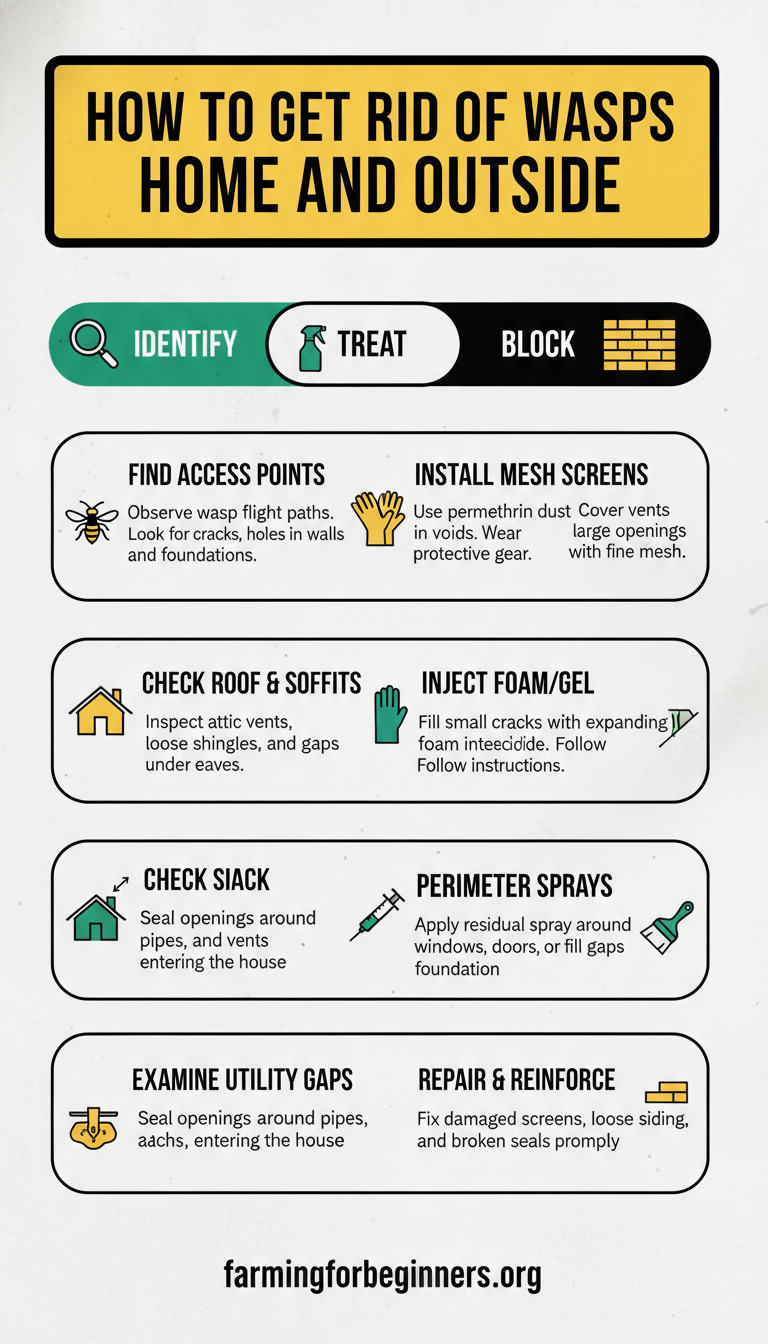
For nests in lofts, eaves, fascia, or similar areas, the most important part is often what you do after the initial treatment.
Treat first, then block the access point
A DIY case described on GOSFORTH Handyman involves treating wasp access when a nest was accessible from inside a loft, then blocking the access hole so wasps couldn’t keep entering. After a day or so, external wasp activity stopped in that example.
Even if your exact situation differs, the logic is solid:
- Wasps may keep coming in if the entrance stays open.
- Blocking helps stop ongoing traffic and reduces the chance of re-nesting.
Use a blocker you can secure safely
You may use a physical angle, fixture, or other method to block the specific opening. The exact approach depends on your structure, but the goal stays the same: deny entry.
If you can’t access and block safely, call a professional
If the hole is inside a wall system or in an area you cannot seal properly afterward, you’re likely doing extra work without finishing the job. That’s a good time to hand it off.
Step 7: Clean the nesting site after treatment to reduce return
Even after you treat or remove a nest, lingering signals can attract wasps back.
Clean for pheromones and “return cues”
A reddit pest-control thread suggests cleaning the original nesting site with white vinegar to remove pheromones that wasps leave behind that can help them find their nest again.
Make it part of your finishing steps
After activity slows or stops:
- Wipe down the entry area.
- Focus on the spot you see wasps using.
- Allow it to dry.
- Don’t re-open or leave gaps that would give them an easy entry again.
Step 8: Prevent wasps from coming back using deterrents and exclusion
Now that the nest issue is addressed, you’ll get better results by making your home less attractive.
Exclusion: seal and deny access
- Seal cracks and gaps around doors, windows, and siding.
- Keep blocked access points blocked.
- If you see a new spot starting to get active, act early before it becomes established.
Remove attractants
Wasps forage for sugars and proteins. Practical steps include:
- Keep trash lids closed and bins cleaned.
- Wipe down sweet spills on outdoor tables.
- Store pet food securely.
- Avoid leaving drinks uncovered outside.
Simple scent deterrents people mention
Community sources suggest natural or household scents that may help deter wasps:
- Mint
- Garlic
- Irish spring soap (mentioned as a helpful deterrent in a community post)
I treat these as “support steps,” not guaranteed solutions. If there’s an active nest nearby, deterrents alone usually won’t beat the underlying cause.
Tips
- Don’t swat. Move calmly. Swatting can provoke wasps and increase sting risk.
- Work early. For nest work, Michigan State University Extension points to early morning as a preferred treatment time.
- Aim at the opening for ground nests. MSU Extension specifically describes dust directed at the entrance for colony spread.
- Block after treatment. Use the “treat then deny entry” mindset borrowed from structural-entry examples like the loft access blocking described by GOSFORTH Handyman.
- Clean with white vinegar. A pest-control discussion recommends it to remove pheromone traces that may draw wasps back.
- Expect imperfect knockdown indoors. Kitchen Stewardship notes the knockdown and window-throw approach can be unreliable, so plan to remove knocked wasps directly.
FAQ
Are wasps dangerous to remove myself?
They can sting, especially if you’re near a nest or if they feel threatened. If the nest is hard to access (like within eaves or loft spaces), the safest approach is often to call a professional. For DIY work, reduce risk first: proper clothing, calm movement, early timing, and a plan for blocking access afterward.
What is the safest way to handle wasps inside my house?
The safest DIY approach is usually knockdown first and remove afterward. According to Kitchen Stewardship, household sprays can coat and knock down wasps. After they’re knocked down, remove them carefully with a container or tools instead of grabbing them with bare hands.
Will household sprays kill wasps every time?
Not always. Kitchen Stewardship explains the coating approach can work because wasps can be affected when their exoskeleton is coated, but it may not reliably kill every wasp in every situation. That’s why I treat it as a knockdown step and then remove calmly.
I found a wasp nest in the ground. How do I know where to treat?
You treat the nest opening you see wasps entering and leaving from. Michigan State University Extension emphasizes directing insecticidal dust at the nest opening, so wasps pick it up and carry it into the nest.
Should I clean the area after treatment?
Yes, it’s a smart follow-up. A pest-control thread suggests cleaning with white vinegar to remove pheromones left behind so wasps are less likely to return to the same spot.
What if the wasps stop showing up for a day, then return?
That usually means one of two things:
- The nest was not fully eliminated.
- The entry point was not blocked, so wasps can re-enter.
If you’ve treated outside, re-check the access point and ensure it’s blocked. If you cannot access or block the site safely, it’s time for professional help.
Latest Updates or ## 2026 Trends
In 2026, more homeowners are leaning into a “two-track” approach: quick indoor knockdown to reduce immediate danger, paired with prevention-focused exclusion outside. The most consistently recommended pattern across practical guidance is not just killing wasps, but blocking entry points and cleaning nest sites afterward to reduce re-entry. You’ll also see more people using non-professional deterrents like mint, garlic, and Irish spring soap as an add-on, while treating nest access as the real long-term fix.
Conclusion
Getting rid of wasps at home and outside is easiest when you think in two tracks. For indoors, do a safe knockdown with household spray and then remove the wasps you knock down. For outdoors, treat the nest at the entry point—ground nests with insecticidal dust directed at the opening—and finish by blocking access so they can’t keep coming back. Finally, clean the nesting site (white vinegar is a commonly suggested option) and reduce attractants around your home so you’re not “re-inviting” wasps the next time they scout your area.
References
- Kitchen Stewardship (Katie Kimball). (n.d.). Natural Wasp Killer – Get Rid of Wasp Nests Without Chemicals. https://www.kitchenstewardship.com/natural-wasp-killer/
- Michigan State University Extension. (n.d.). Getting rid of wasp nests. https://www.canr.msu.edu/news/getting_rid_of_wasps_nests
- GOSFORTH Handyman. (n.d.). How to kill a wasp nest – DIY method! https://gosforthhandyman.com/how-to-remove-wasp-nest/
- reddit (r/lifehacks). (n.d.). Keep wasps away (community suggestions like mint, garlic, Irish spring soap). https://www.reddit.com/r/lifehacks/comments/1c1g884/keep_wasps_away/
- reddit (r/pestcontrol). (n.d.). Any wasp nest removal tip? (suggestion to clean with white vinegar to remove pheromones). https://www.reddit.com/r/pestcontrol/comments/1fctxft/any_wasp_nest_removal_tip/

Samuel Michael
I've have been involved in Backyard Farm for over 15 years, especially livestock and market gardening. I blog at my free Time and ive My most helpful thoughts on this blog.
