


If I’ve learned anything from companion planting charts, it’s that the right vegetable “neighbors” can make my garden feel calmer and more productive fast. When compatible plants share space, I waste less time guessing and more time harvesting. Companion planting helps me build diverse beds where different crops use space better, support each other’s growth habits, and can face fewer pest problems. It also helps beginners because charts give me starting points I can test, then tweak based on what happens in my yard. Use the ideas below as a practical “mix and match” plan, and you’ll be able to create neighboring beds that make sense for your layout and your schedule.
Quick Answer
These 14 vegetables (beets, broccoli, cabbage, carrots, corn, cucumbers, green beans, lettuce, onions, peas, peppers, potatoes, tomatoes, zucchini) grow well together in companion “neighborhoods” when I pair them with the chart-frequent helpers like radishes, legumes (beans and peas), and onion-family plants, plus brassicas grouped with compatible roots and radishes.
Key Takeaways
- Companion planting is about smarter plant combinations for shared space benefits like growth patterns and helpful pest-management companions.
- The most consistent “glue” crops across reputable charts are legumes (beans and peas), radishes, and onion-family plants.
- Nightshades (tomatoes and peppers) often get placed together because their care needs overlap and pest control strategies can be shared.
- Corn is often used as a “support neighbor” because it can add wind protection and shade for nearby crops.
- Start small: test 2 or 3 mixed beds first, then expand once you see how your local conditions respond.
1. What “Grows Well Together” Means in Companion Planting

Companion planting is when I grow plants in helpful combinations in the same bed or close by, aiming for benefits like:
- Better use of space (tall crops near shorter ones)
- Compatible growth habits (root depths and spread that don’t fight)
- Pest-management helpers (some plants attract or confuse pests)
- Simpler day-to-day care because neighbors often want similar conditions
Guidance Can Vary, and I Still Use It
I’m not treating companion planting as strict rules that must never change. Different guides list different pairings, and local pests matter. What stays consistent across many reputable garden references is that a few vegetables show up again and again as good neighbors.
For example, The Old Farmer’s Almanac and Farmers’ Almanac both provide companion lists by crop, and they repeatedly suggest pairings like cucumbers with lettuce and radishes, and green beans with corn and peas. UFseeds’ companion lists also reinforce several overlapping “compatible networks,” which is exactly what I look for when planning my beds.
2. 14 Vegetables That Can Be Combined Into Productive Neighboring Beds

Here are the 14 vegetables I’ll focus on, grouped into practical “neighborhoods” that make it easier for me to plan:
- Root and underground neighbors: beets, carrots, onions, potatoes
- Leafy and quick-space fillers: lettuce
- Legume neighbors (soil supporters): green beans, peas
- Brassica block: broccoli, cabbage
- Tall support and shade helpers: corn
- Fruit and vine neighbors: cucumbers, peppers, tomatoes, zucchini
How I Think About Their “Neighborhoods”
When I arrange these, I usually build beds around a few roles:
- Fruiting core: tomatoes and peppers (nightshades) plus zucchini or cucumbers depending on space
- Support layer: corn near crops that benefit from wind protection or light shade
- Legume support: green beans and peas placed where they fit well with the rest of the bed
- Root edges: onions, carrots, beets, and radishes working along the perimeter or between rows
- Brassica zone: broccoli and cabbage together, with radishes as a common chart-friendly companion
3. Best Companion Pairings for Each Vegetable (Practical Neighbor Lists)

Below are practical “neighbor lists” I use when building mixed beds with these 14 vegetables. I’m using guidance that shows up clearly in reputable companion-planting charts.
Beets
Common neighbors to try: carrots, radishes. Beets tend to fit well in mixed root-and-leaf beds. If I’m creating a border that needs color and space efficiency, I’ll often place beets near carrots and radishes.
Broccoli
Common neighbors to try: legumes like peas or beans, plus compatible brassica-friendly companions. Companion charts commonly suggest broccoli alongside radish helpers and other garden “mix-in” crops, so I treat broccoli as a core of a brassica block rather than a solo star.
Cabbage
Common neighbors to try: radishes, and other compatible brassica-zone companions. Cabbage is another brassica I often group with broccoli, then add radishes to help create that chart-favorite mixed pattern.
Carrots
Common neighbors to try: onions and other root/leaf mixes, plus radish for fast-gap coverage. When I plan a carrot row, I like pairing it with onion-family plants and using radishes between slower crops to keep the bed productive.
Corn
Common neighbors to try: green beans, peas, and other crops that benefit from shelter. Corn is one of those “power neighbors” in companion charts. I use it to:
- Reduce wind stress for more delicate crops
- Provide partial shade for plants that appreciate lighter afternoon intensity
Cucumbers
Common neighbors to try: beans, peas, radishes, lettuce, dill, plus marigolds or nasturtiums when included. Cucumbers are one of the most chart-covered companion crops. I love them in mixed beds because I can build around them with lettuce or radishes for spacing and quick productivity.
Green beans
Common neighbors to try: corn, peas, potatoes, radishes, and cabbage-family members. Green beans show up constantly with corn and peas. If I’m creating a “support + mix” bed, I place beans where they can share space with corn and still fit cleanly next to other compatible crops.
Lettuce
Common neighbors to try: chives or mint as companion herbs, plus leafy-friendly mixing with cucumbers and other chart-paired crops. Lettuce is my favorite “starter filler.” In mixed plantings, it helps me occupy space while slower plants get established.
Onions
Common neighbors to try: green beans and many mixed-vegetable pairings. Onions are one of the simplest add-ons. I often place them among mixed beds because many companion charts keep recommending onion-family plants as helpful neighbors.
Peas
Common neighbors to try: beans and radishes, plus some cucumber-adjacent pairings. Peas are a great match for beds where I want legumes to do some heavy lifting. I also like how they fit with quick companions like radishes.
Peppers
Common neighbors to try: tomatoes, plus pest-deterring companions that charts suggest around nightshades. I usually grow peppers near tomatoes because their care needs line up. Companion charts also support using “shared companions” to reduce pest pressure across the nightshade group.
Potatoes
Common neighbors to try: green beans and other compatible mixed-bed neighbors. Potatoes commonly appear as a companion for green beans in companion guides. That pairing is especially useful for me because it helps me plan a practical bed layout without overthinking.
Tomatoes
Common neighbors to try: peppers, plus other chart-listed companions that help manage pests. Tomatoes and peppers are a classic companion pairing. I treat them like a single “nightshade zone,” then surround them with compatible plants that fit the same care rhythm.
Zucchini
Common neighbors to try: cucumber-compatible partners like lettuce, and squash-family compatible neighbors shown in chart lists. Zucchini is often grouped with cucumber-friendly mixes. In practice, I place it where it has room to spread but still shares a bed with crops that can tolerate its presence.
A Simple Way to Build Your Own Neighbor Lists
If you want to do this fast, I use a three-step shortcut:
- Pick one “core” crop for the bed (like cucumbers or tomatoes)
- Add chart-frequent neighbors (especially radishes, beans, peas, and onions)
- Fill gaps with quick growers like lettuce so the bed stays productive
4. Build a “Mixed Bed” Example Using the 14 Vegetables (Layout Ideas)
Here’s one layout idea I’d use as a starting point, using the “roles” approach.
Layout Goal: A Bed With Support, Filling, and Variety
I’ll sketch out a concept bed like this:
- Center fruiting zone: tomatoes + peppers
- Support strip: corn near the back or one side
- Vining zone: cucumbers and/or zucchini where space allows
- Legume block: green beans and peas near corn and within reach of watering
- Root and edge layer: onions, carrots, beets, and radishes along edges and gaps
- Brassica block: broccoli and cabbage together, with radishes as the chart-friendly helper
How I Place Them in Real Life
#### Use spacing tricks that match how these plants grow
- Corn goes where it has room to stand tall.
- Lettuce goes where it can get light without being shaded too heavily.
- Radishes go in gaps because they’re often quick to grow and fit between slower plants.
#### Add “neighbors” based on repeated chart pairings From the companion guidance I’m using, I lean heavily on these overlap favorites:
- Cucumbers next to lettuce and radishes
- Green beans next to corn and peas
- Tomatoes next to peppers
- Brassicas like broccoli and cabbage next to radishes and compatible mixed-bed neighbors
- Onions threaded through mixed beds
A quick “bed checklist” I use
- Can I reach each plant easily for watering and pest checks?
- Are tall plants set so they won’t completely block light from short crops?
- Do I have a mix of roots and leafy crops so they don’t crowd the same space?
- Did I include chart-favorite companions like radish and legumes?
5. How to Use Companion Planting for Timing and Management

Companion planting works best for me when I plan care as well as space.
Match care needs so I can manage the bed easily
I group crops with similar habits so my routine stays simple:
- Nightshade zone: tomatoes and peppers share a similar “management rhythm,” especially when I’m checking for common pests and planning watering.
- Vining zone: cucumbers and zucchini want consistent space planning and steady attention.
- Leafy fillers: lettuce helps me keep ground covered while I wait for slower crops to grow bigger.
- Legume block: peas and green beans fit well as neighbors because they blend into mixed beds without forcing a totally different routine.
Use chart-recommended neighbors to reduce pest pressure
I don’t rely on companions as magic. But diversified planting helps my garden stay resilient. When I place chart-friendly companions together, I can:
- Spread out pest risk across multiple crops
- Add plants that may interrupt pest movement
- Keep the bed “busy” so one pest problem doesn’t take over as quickly
6. Quick Reference Table (Neighboring Pair Suggestions)
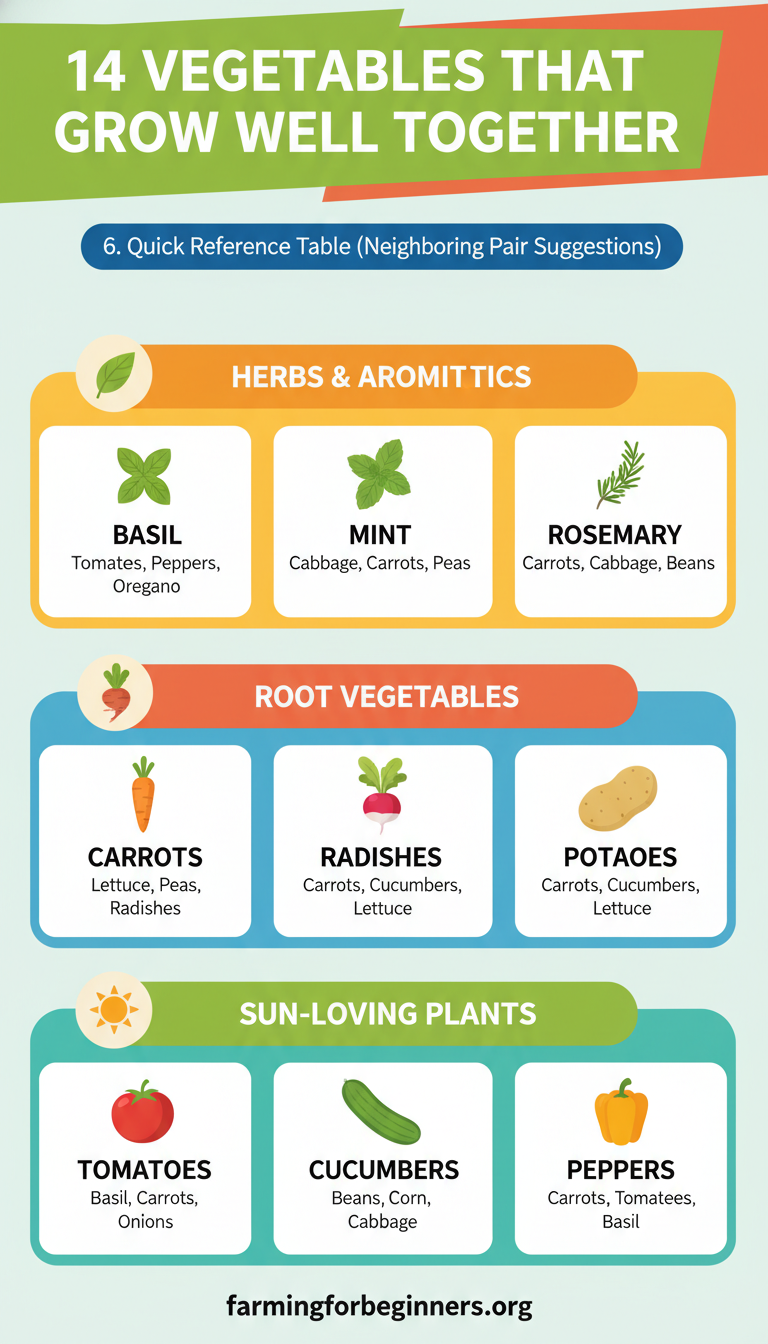
Here’s a quick visual to help me plan pairings at a glance.
| Vegetable (from the 14) | Neighbor suggestions I commonly use from chart guidance |
|---|---|
| Cucumbers | Beans, peas, radishes, lettuce, dill |
| Green beans | Corn, peas, potatoes, radishes, cabbage-family neighbors |
| Tomatoes | Peppers and other compatible chart companions for nightshades |
| Peppers | Tomatoes, plus pest-supporting companions suggested around nightshades |
| Corn | Beans and peas, plus crops that benefit from wind protection or shade |
| Lettuce | Chive and mint (herb companions), plus cucumber-friendly mixing |
| Onions | Often paired in mixed charts, including next to green beans |
| Peas | Beans and radishes, plus some cucumber-adjacent pairings |
| Broccoli | Legume-friendly neighbors and radish-style companions |
| Cabbage | Radishes and compatible mixed-bed neighbors |
| Carrots | Onions and radishes in root-focused mixes |
| Beets | Carrots and radishes |
| Potatoes | Green beans |
| Zucchini | Cucumber-compatible mixes like lettuce and similar compatible neighbors |
“Most Frequent Pairings” I see across sources
- Cucumbers + lettuce
- Cucumbers + radishes
- Cucumbers + beans and peas
- Green beans + corn
- Green beans + peas
- Green beans + potatoes
- Green beans + radishes
- Tomatoes + peppers
- Broccoli and cabbage + radishes
- Onions + mixed beds including green beans
7. Notes, Limitations, and Next Steps

Understand the limits
Companion planting charts are guidance, not guarantees. I always keep these realities in mind:
- Pairings may work differently depending on your local climate and pests.
- Some cultivars behave differently, especially with spacing needs.
- Too much crowding can cause disease problems even when companions are “compatible.”
My best next steps (so you actually get results)
- Start with one mixed bed using 6 to 8 of these vegetables, then expand.
- Observe for two to four weeks: pest pressure, leaf color, and soil moisture balance.
- If something struggles, adjust placement next season instead of giving up on the whole idea.
A quick “test strategy” I recommend
- Choose one core crop (like cucumbers or tomatoes).
- Add two chart-friendly companions (like radishes and lettuce).
- Keep everything else simple for that first test bed.
- Record what worked: spacing, watering ease, and how pests behaved.
Common Mistakes

Here are the mistakes I see most often when people try companion planting for the first time:
- Overcrowding the bed. Even compatible plants can fail if they’re packed too tight.
- Planting companions but ignoring sunlight. Tall crops like corn can shade short crops if I don’t place them carefully.
- Treating charts as rules that never change. I still adjust based on my soil, pests, and weather.
- Forgetting access for watering and checks. If I can’t reach plants easily, I won’t manage pests or stress quickly.
- Skipping soil prep. Companion planting doesn’t fix poor soil fertility or drainage.
- Planting too many “experiments” at once. I get better results by starting with one mixed bed and learning from it.
FAQ

Do I need to plant all 14 vegetables together?
No. I usually start with 6 to 8 and build outward. You can still use the same neighbor ideas even if your bed is smaller.
Are radishes always a good companion?
Radishes show up repeatedly as a recommended companion in the chart guidance I used, including with cucumbers and green beans. That said, I still plant them in a way that matches my spacing and growth timing.
Why do tomatoes and peppers get paired so often?
Many companion guides treat nightshades together because they share management needs. In practical gardening, that can make pest checks and care routines easier, and chart guidance often lists pepper and tomato pairings together.
Can I use companion planting in containers?
Yes. For containers, I reduce the number of plants per pot. I focus on close companions like herbs with leafy crops and small root neighbors, and I keep taller crops from shading everything.
What if pests show up anyway?
Companion planting helps reduce risk, but it doesn’t stop pests completely. When pests appear, I respond by checking plants early, improving airflow, removing heavily affected leaves, and keeping the bed balanced.
Latest Updates or ## 2026 Trends

In 2026, I’m seeing a clear trend toward simpler companion plans: fewer crops per bed, more repeatable “templates,” and more attention to practical management (watering access and easy pest checks). Instead of memorizing dozens of pairings, many gardeners use chart-backed staples like radishes as gap-filling companions, beans and peas as consistent legume neighbors, and tomatoes paired with peppers as a nightshade zone.
If you want a 2026-friendly approach, I’d do this:
- Pick one bed template (nightshade zone, cucumber zone, or brassica block)
- Add 2 to 4 chart-frequent companions
- Build consistency year to year so you can spot what truly works in your yard
Conclusion
Companion planting is one of those gardening ideas that feels like a cheat code once you start using it. With these 14 vegetables, I can build mixed beds where tall crops, vines, leafy fillers, roots, legumes, and brassicas fit together in a way that’s easier to manage and often more resilient against pest problems.
If you remember nothing else, remember this: start with a few chart-frequent neighbors like radishes, green beans and peas, onions, and a nightshade zone for tomatoes and peppers. Build one test bed first, observe what happens, and let your results guide your next round of planting.
References
- The Old Farmer’s Almanac. (n.d.). Companion Planting Chart (Free Printable, Research-Based). https://www.almanac.com/companion-planting-guide-vegetables
- Farmers’ Almanac. (n.d.). Companion Planting Guide. https://www.farmersalmanac.com/companion-planting-guide
- UFseeds. (n.d.). Companion Planting. https://www.ufseeds.com/companion-planting.html?srsltid=AfmBOopjjr0UeAgfjOtYPr7eNtonOVDUaWJwQbanvAWJSsS04VlHKuv-
- UFseeds. (n.d.). Companion Planting (alternative list view). https://www.ufseeds.com/companion-planting.html?srsltid=AfmBOorjUy0cmZ2PKDZlyocyrhQMETsHmLDRBAS9M2FqSBy3YP9i3GEE
- Simple Frugal Life. (2023). 6 Common Vegetables That Benefit From Companion Planting. https://simplefrugallife.org/2023/05/09/6-common-vegetables-that-benefit-from-companion-planting/

Samuel Michael
I've have been involved in Backyard Farm for over 15 years, especially livestock and market gardening. I blog at my free Time and ive My most helpful thoughts on this blog.

