

What makes pruning tomato plants feel confusing one week and crystal clear the next? If you’ve tried “tomato sucker pruning” or “prune indeterminate tomatoes,” you already know the key is timing and how you spot growth points—especially in summer heat when plants can get out of hand fast. Pruning tomato plants helps you keep a beginner-friendly, easy routine that still supports a quick harvest. With the right method, you’ll tame overgrown vines for backyard dinners, weekend grilling, or even a cozy holiday gift idea like a homegrown sauce starter—so let’s get your tomato pruning right.
Key Takeaways
- Tomato pruning mainly targets suckers: branches that grow from leaf axils on the main stem.
- A common approach is removing every sucker below the lowest flower or fruit cluster while leaving the upper growth to develop.
- You must be able to identify suckers first; otherwise, you’ll prune inconsistently.
- Scouting (checking plants regularly) is key because suckers can keep showing up.
- After pruning, keep an eye on plant vigor and fruit set, then re-scan as needed.
Quick Answer
To prune tomato plants, start at the main central stem and check every leaf axil (the junction where a leaf meets the stem). Pinch or remove suckers—extra shoots growing from that “V.” Then use a simple rule: remove every sucker below the lowest flower or fruit cluster, and leave the suckers above that point so the plant can keep flowering and fruiting.
What You Need
| Item | Purpose | Notes |
|---|---|---|
| Clean hands or gardening gloves | Safer, more controlled pinch removal | If your nails are short, gloves can help you grab better |
| Sharp pruners (optional) | Clean cuts for larger or thicker suckers | Use for plants where pinch removal feels too tough |
| Disinfectant (70% isopropyl alcohol or similar) | Reduce risk when cutting repeatedly | Wipe blades between plants if you see disease |
| Small bucket or bowl | Collect removed suckers | Keeps your work area tidy |
| Bright light or phone flashlight | Helps you see leaf axils clearly | Great for dense plants or cloudy days |
| Labeled plant stake or marker (optional) | Helps you track which “cluster line” you chose | Especially useful if you prune more than one plant |
| Notebook or phone notes | Track dates and what you removed | Tomato pruning is easier when you remember your last pass |
Step 1: Know why pruning matters (and what you’re trying to fix)
Pruning tomato plants is not just about making them look neat. It’s mainly about controlling growth so the plant doesn’t become overly dense and tangled.
When you leave suckers to grow unchecked, the plant can turn into something far more vigorous than what you planned—more stems, more leaves, and a harder time for the plant to focus energy where you want it. According to The Art of Doing Stuff, leaving suckers can transform an orderly tomato plant into a “gigantic, hungry, aggressive monster,” which is exactly what good pruning helps you prevent. This is also why pruning can feel like it “works” quickly: you’re redirecting the plant’s energy and airflow potential toward productive growth.
One more reason: suckers can become additional plants if allowed to root. Gardenary explains that suckers can grow into what is essentially another plant, which means pruning also helps reduce unwanted proliferation in your garden space.
What you’ll be doing, in plain language
- You’ll spot the extra shoots (suckers) growing in the leaf “V.”
- You’ll remove the ones that are below your chosen fruiting level.
- You’ll let the rest of the plant keep building flowers and fruit.
Step 2: Identify a tomato “sucker” before you remove anything
If you get this part right, the rest is easy. A tomato sucker is a branch that forms in the leaf axils, the junction between true leaves and the main stem.
According to Wisconsin Horticulture, suckers are branches that form in the leaf axils (the space where the leaf meets the main stem). This is the exact location you should examine every time you prune.
Where to look (the “elbow” of the plant)
A practical scouting trick is to look at the spot where a leafy branch meets the main stem—the “elbow” or junction. Gardenary describes suckers as extra little vines that start from that axil point, and they emphasize that learning to locate them comes first, before you decide how much to remove.
Use guides if you need a confidence boost
If you’re unsure, visual training helps. The Art of Doing Stuff recommends scouting from the main central stem upward and checking each leaf-emergence “V” for something extra growing out of it, and it pairs that advice with photos to make identification more straightforward. Videos from gardening educators can also help you practice seeing those junctions quickly (for example, YouTube tomato sucker identification videos).
Step 3: Scout your plant the right way (so you don’t miss axils)
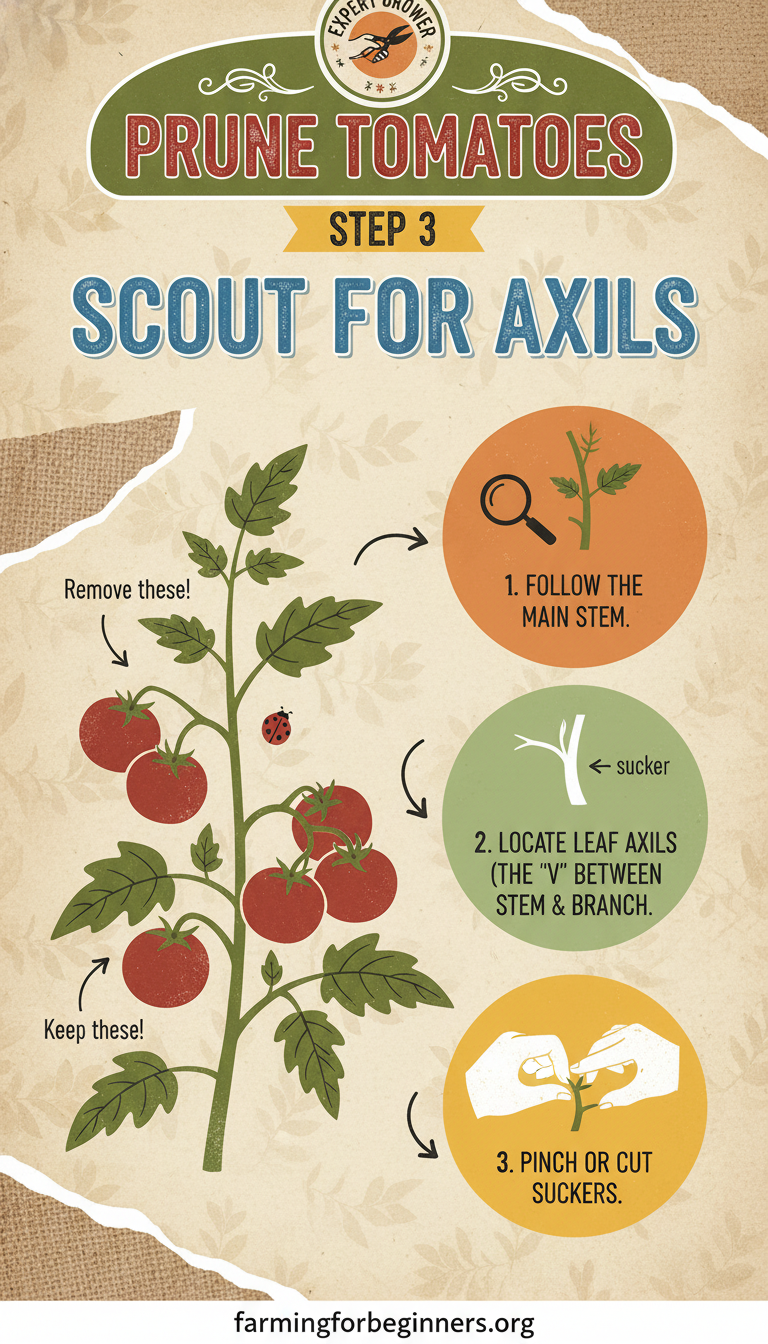
Now that you can recognize suckers, your next job is to scout thoroughly and consistently.
Start at the main central stem (the main backbone of your plant). Then work upward from the base. At every spot where a leaf emerges along the main stem, check the junction.
A simple scouting path you can follow
- Find the main central stem.
- Move your eyes from the ground upward.
- At each leaf emergence point, look at the “V” between the leaf and the main stem.
- If you see a new shoot coming out of that axil area, treat it as a sucker candidate.
According to The Art of Doing Stuff, the easiest method is to follow the central stem and check each leaf junction “V” for additional growth.
If your plant is dense, slow down
Dense plants can hide axils under leaves. That’s normal. Use bright light or a phone flashlight and gently move leaves aside while you look. Don’t yank stems. If you use pruners, keep your hand steady and make clean cuts.
Step 4: Use the “lowest cluster” pruning method (the common approach)
Here’s the core pruning strategy many gardeners use because it’s clear and repeatable.
First, locate the lowest flower or fruit cluster on the plant—the cluster closest to the ground. Then remove every sucker below that lowest cluster.
According to Wisconsin Horticulture, a common pruning approach is to remove every sucker from the plant except for the first one below the lowest flower or fruit cluster. That sucker is typically left to continue developing. In many home gardens, people express this as “remove suckers below the lowest cluster line, keep what’s above it.”
Why this method works
- It keeps the plant productive above your pruning line.
- It reduces the number of extra stems competing for space and energy.
- It gives your plant a more predictable structure as it grows.
How you decide what counts as “below”
A quick rule of thumb:
- If the sucker is growing from an axil that sits visually below the lowest flower/fruit cluster, remove it.
- If the sucker is at or above that lowest cluster level, you generally leave the upper structure to keep flowering.
Step 5: Choose your pruning intensity (how much to remove)
Not every tomato plant needs the same level of pruning. Your “intensity” depends on how controlled you want your plant to be and how vigorous it is.
Start with a realistic goal
For most backyard gardeners, the goal is:
- Reduce excessive vegetative growth
- Keep airflow through the plant
- Maintain fruiting
- Avoid a messy, overgrown tangle
According to Wisconsin Horticulture, pruning depends on identifying the main stem and suckers first, then following a consistent rule about what to remove. That consistency matters as much as the amount.
A practical way to set your intensity
- If your plant is getting very leafy fast, be more selective and remove more suckers below the cluster line.
- If it’s growing more slowly, you can prune more lightly while still removing the key low suckers.
- If the plant is already thin and stressed, avoid aggressive pruning that strips too much growth at once.
Remember: you’re pruning suckers, not “random branches”
It’s easy to get overconfident and start removing stems that are actually part of the main structure. Stick to axils and sucker points. If you aren’t sure, pause, re-check the leaf junction, and confirm what you’re removing.
Step 6: Prune with a checklist workflow (so you don’t miss things)
Let’s turn everything above into a simple workflow you can repeat.
Practical pruning checklist
- Locate the main central stem.
- Scan each leaf axil along the stem for sucker growth.
- Find the lowest flower/fruit cluster closest to the ground.
- Remove targeted suckers, especially those below the lowest cluster line (using the guidance from Wisconsin Horticulture).
- Re-check after pruning to ensure you didn’t miss additional axil growth points.
According to The Art of Doing Stuff, this “follow the central stem and check each V” method is the scouting backbone that prevents missed suckers.
How to remove suckers (pinch vs. cut)
- Pinch removal: Often works best for smaller suckers. Use clean hands or gloves and pinch the sucker close to where it starts.
- Cut removal: Use sharp pruners if suckers are thicker or harder to pinch. Make a clean cut and avoid tearing.
If you’re pruning multiple plants, wipe pruners between plants as a basic sanitation habit—especially if any plant looks unhealthy.
Step 7: Avoid common pruning mistakes that wreck structure
Even experienced gardeners can make mistakes here. The good news is most issues are fixable with better identification and consistency.
Mistake 1: Not recognizing suckers
If you remove the wrong growth points, you can disrupt plant structure and reduce fruiting. Gardenary emphasizes that suckers must be identified before you decide how much to prune.
Mistake 2: Pruning inconsistently
You don’t want to remove some axil growth but leave others at the same level. That often creates uneven structure and more crowding. Stick to your scouting path and your “lowest cluster” line rule.
Mistake 3: Leaving too many suckers below the cluster
If your goal is control, leaving extra low suckers can cause the plant to become more vigorous and denser than you planned. As The Art of Doing Stuff warns, unchecked suckers can quickly create a larger, more aggressive plant.
Mistake 4: Cutting without re-checking
After pruning, do a second quick scan. Sometimes you prune one side and miss axils on the other side. A re-check is one of the easiest ways to keep pruning effective without doing extra work.
Step 8: Aftercare and expectations (what happens next)
Pruning is not a one-and-done task. Tomato plants keep growing, and suckers can keep appearing.
What to expect right after pruning
- The plant may look “lighter” and less bushy.
- New growth will still continue from remaining shoots above your pruning line.
- In many gardens, you may notice the plant staying more manageable rather than spiraling into dense foliage.
Plan for periodic re-scanning
Because suckers can develop quickly, make pruning part of your regular plant care routine. Wisconsin Horticulture stresses using illustrated guides to identify suckers and follow a consistent strategy, which implies the work is repeated over time as new growth forms.
Monitor fruiting and adjust
After a pruning session:
- If fruit clusters are continuing normally, you’re probably pruning at the right intensity.
- If the plant seems stressed or fruiting slows, reduce how aggressively you prune next time.
- If the plant is still getting out of control, tighten up by removing the low suckers you missed and repeating the process sooner.
Tips
- Prune on a calm day: You’ll see axils better when leaves aren’t being shaken around by wind.
- Don’t overthink the first pass: Get accurate with identification first, then refine intensity.
- Use consistent timing: Re-scan every week or whenever growth seems to explode.
- Stay focused on leaf axils: Your target is the junction between the leaf and the main stem.
- Sanitize tools when needed: If you cut thicker parts, wipe pruners between plants as a precaution.
- Choose one “lowest cluster” line: It keeps your pruning logic simple and prevents random removals.
- If you’re unsure, check visual guides: Illustrated fact sheets and short videos can help you confirm you’re looking at a sucker and not a normal growth branch.
FAQ
Do I have to prune tomato plants?
Not every tomato needs the same level of pruning, but pruning tomato plants is commonly used to control growth and keep the plant manageable. According to Wisconsin Horticulture, a key step is locating suckers in leaf axils and then following a strategy based on your lowest cluster so the plant keeps fruiting without becoming overly dense.
Are “determinate” and “indeterminate” tomatoes pruned the same way?
The basic identification of suckers in leaf axils is the same skill. However, your pruning intensity and structure goals can differ. The methods described here focus on a common sucker-control approach (especially relevant for vining, continuously growing types). If you tell me your tomato variety, I can suggest a more tailored pruning plan.
How often should I prune tomato suckers?
Suckers keep forming, so you’ll want to scout regularly. When you notice new sucker growth at leaf axils, that’s your cue to repeat the check-and-remove steps using the lowest cluster line method.
What if I accidentally remove a fruiting branch?
If you removed something other than a true sucker, you might reduce your near-term fruit set. The best fix is to stop and re-scan: confirm the main stem and your cluster line, then prune only clear axil suckers going forward. Going forward, focus strictly on the junction shoots described by Wisconsin Horticulture and Gardenary.
Can tomato suckers really root and become new plants?
Yes. Gardenary explains that suckers are capable of becoming an entirely new plant if allowed to root. That is one reason pruning can reduce unwanted plant “proliferation” in your garden space.
Latest Updates or ## 2026 Trends
In 2026, I’m seeing more gardeners use “scouting-first” methods (instead of pruning by habit) because it prevents over-pruning. Practically, that trend looks like:
- Checking each leaf axil methodically along the main stem before removing anything.
- Using simple “lowest flower/fruit cluster” rules to decide what to keep.
- Relying more on clear visual guides (fact sheets and short videos) to learn sucker identification faster.
Those ideas line up with the fundamentals from Wisconsin Horticulture (identify suckers in leaf axils and use illustrations as guidance) and the scouting method described by The Art of Doing Stuff (follow the main central stem and check every “V” where leaves emerge).
Conclusion
Pruning tomato plants gets easier the moment you treat it like a repeatable skill: identify suckers in leaf axils, scout from the main stem upward, and use the lowest flower or fruit cluster as your decision line. When you remove those targeted suckers, your plant stays more organized, less tangled, and less likely to become a dense, overly vigorous mass—while still keeping plenty of growth above to produce fruit.
Now you’ve got a clear, step-by-step way to prune tomatoes. Grab your gloves, pick your lowest cluster line, and do your first tidy scouting pass today.
References
- The Art of Doing Stuff. (n.d.). Pruning Tomato Suckers – How & When to do it – Give Your Tomatoes a Weave: Pruning and Supporting Tomatoes. https://www.theartofdoingstuff.com/give-your-tomatoes-a-weave-pruning-and-supporting-tomatoes/
- Wisconsin Horticulture (University of Wisconsin–Madison Extension). (n.d.). Tomato Pruning. https://hort.extension.wisc.edu/articles/tomato-pruning/
- Gardenary. (n.d.). Pruning Tomatoes 101: Should You Prune Tomato Suckers? https://www.gardenary.com/blog/pruning-tomatoes-101-should-you-prune-tomato-suckers
- YouTube. (n.d.). Identifying & Understanding Tomato ‘Suckers’ (video). https://www.youtube.com/watch?v=6HmkFbaNM1c
- YouTube. (n.d.). Tomato Suckers 101 – Garden Quickie Episode 251 (video). https://www.youtube.com/watch?v=tYKYmrzoRgU

Samuel Michael
I've have been involved in Backyard Farm for over 15 years, especially livestock and market gardening. I blog at my free Time and ive My most helpful thoughts on this blog.