

Dog barking doesn’t have to run your home. With the right plan, you can teach your dog when to bark—and when to be quiet—without constant yelling or punishment. This guide helps you understand why your dog barks, then gives you practical training steps you can start today. If you live in an apartment, work from home, or have neighbors close by, this will save you stress and keep relationships smooth. You’ll learn how to manage triggers, use simple cues, and build good habits with rewards. By the end, you’ll have a clear roadmap for quieter days and a calmer dog that feels understood.
Key Takeaways
- Barking is communication—before you stop it, you need to figure out what triggers it.
- The fastest results come from combining management (less opportunity to practice barking) with training (teaching “quiet” and alternative behaviors).
- Reward calm behavior and specific “quiet” moments rather than only reacting when barking starts.
- Teach a replacement behavior (like “go to place” or “check it then settle”) so your dog has something to do.
- Consistency matters: use the same cues, rules, and rewards every day.
- For severe or sudden changes, or if barking is driven by anxiety, you may need a vet check or a trainer.
Quick Answer
To stop dog barking, first identify the type and trigger (doorbell, people, loneliness, boredom, fear, excitement). Then use management to reduce exposure to the trigger (close curtains, block sightlines, leash indoors, use baby gates). Next, train an alternative: cue “quiet,” reward silence, and teach a “go to place” or “settle” routine when the trigger appears. Practice short sessions daily and stay consistent with rewards and calm energy.
What You Need
| Item | Purpose | Notes |
|---|---|---|
| Treats (high value) | Rewards for quiet/calm | Use small, tasty treats your dog loves |
| Clicker (optional) | Marks the exact moment of calm | If you use one, keep the timing consistent |
| Leash (indoor use) | Helps you manage distance and control | Especially for reactive barking |
| Baby gate or playpen | Creates a safe “management zone” | Limits rehearsal of barking |
| Door/window barriers (curtains, film, covers) | Blocks visual triggers | Great for window/door barking |
| Chew toy or puzzle feeder | Keeps your dog busy | Use during trigger times |
| Quiet command cue (“Quiet”) | Teaches what “stop” means | Pair with rewards for success |
| Notebook/phone notes | Tracks triggers and patterns | Helps you find what sets off barking |
| Calm enrichment routine | Reduces boredom and excess energy | Short walks, sniffing, training games |
Step 1: Identify Why Your Dog Is Barking (Not Just That They Are)
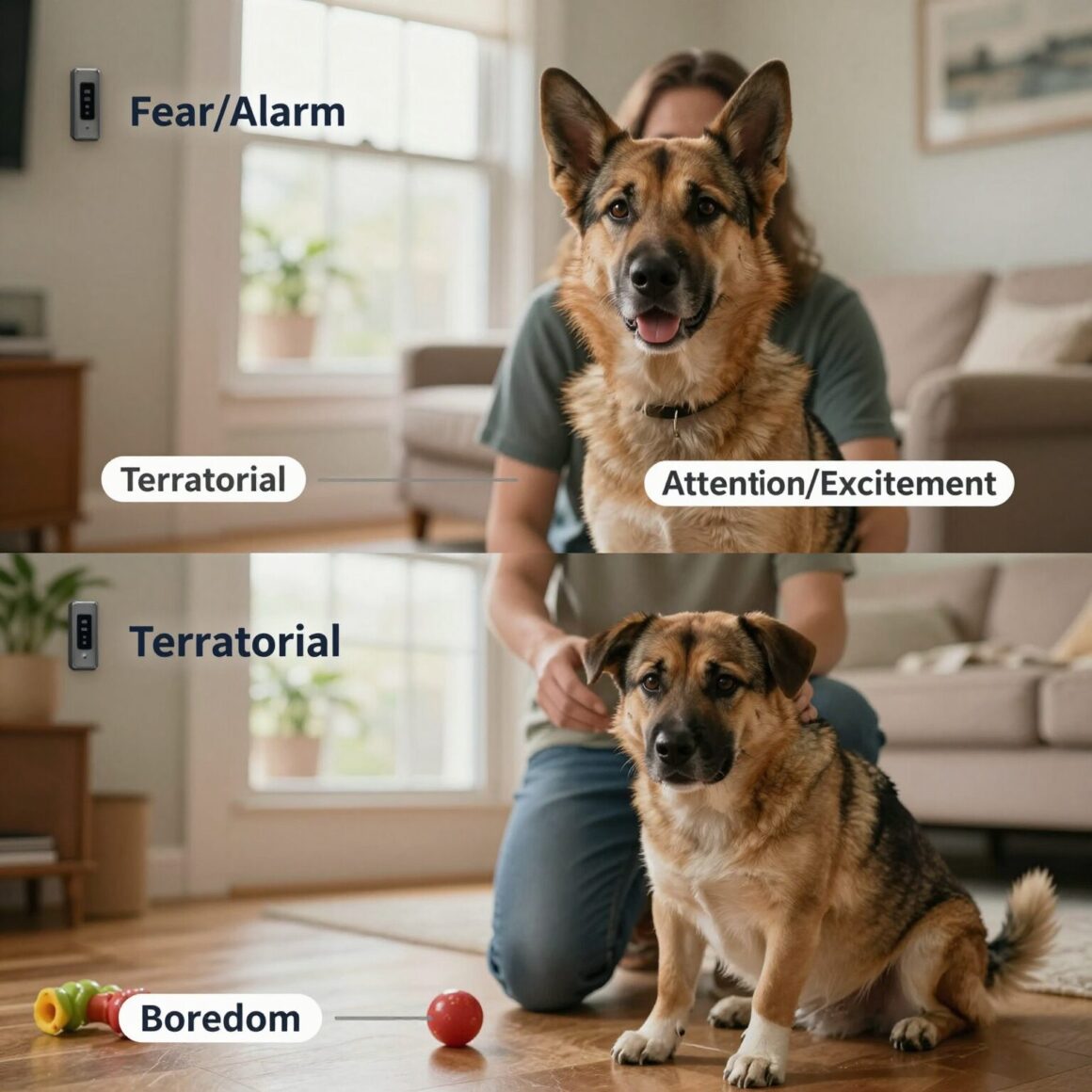
The first thing I do with any barking problem is figure out what’s underneath it. If I only try to “make it stop,” I’m likely fighting the wrong cause.
Common reasons dogs bark:
- Alert barking: They notice something (doorbell, footsteps, mail carrier) and tell you.
- Demand barking: They want something (attention, food, to go outside, play).
- Frustrated barking: They can’t get to what they want (a dog behind a fence, a person through a gate).
- Fear or intimidation: They feel unsafe and bark to protect themselves.
- Loneliness/separation: They bark when you leave or when they’re stuck alone.
- Boredom/overstimulation: They bark because they’re under-exercised or under-stimulated.
- Territorial barking: They bark at their “zone” (yard, doorway, even inside).
How you can identify your dog’s pattern:
- Write down when it happens (time of day, who is around, what they are seeing/hearing).
- Note the body language: Is your dog stiff and staring (alert), jumping for you (demand), hiding (fear), or pacing (anxiety/boredom)?
- Check the trigger: doors, windows, people, dogs, sounds, or being alone.
If you tell me what your dog barks at (doorbell? neighbor? outside noises? when you’re gone?), I can help you pick the best approach. For now, just get clear on the “why” so your training matches your dog.
Step 2: Do Quick Management First (So Practice Stops)
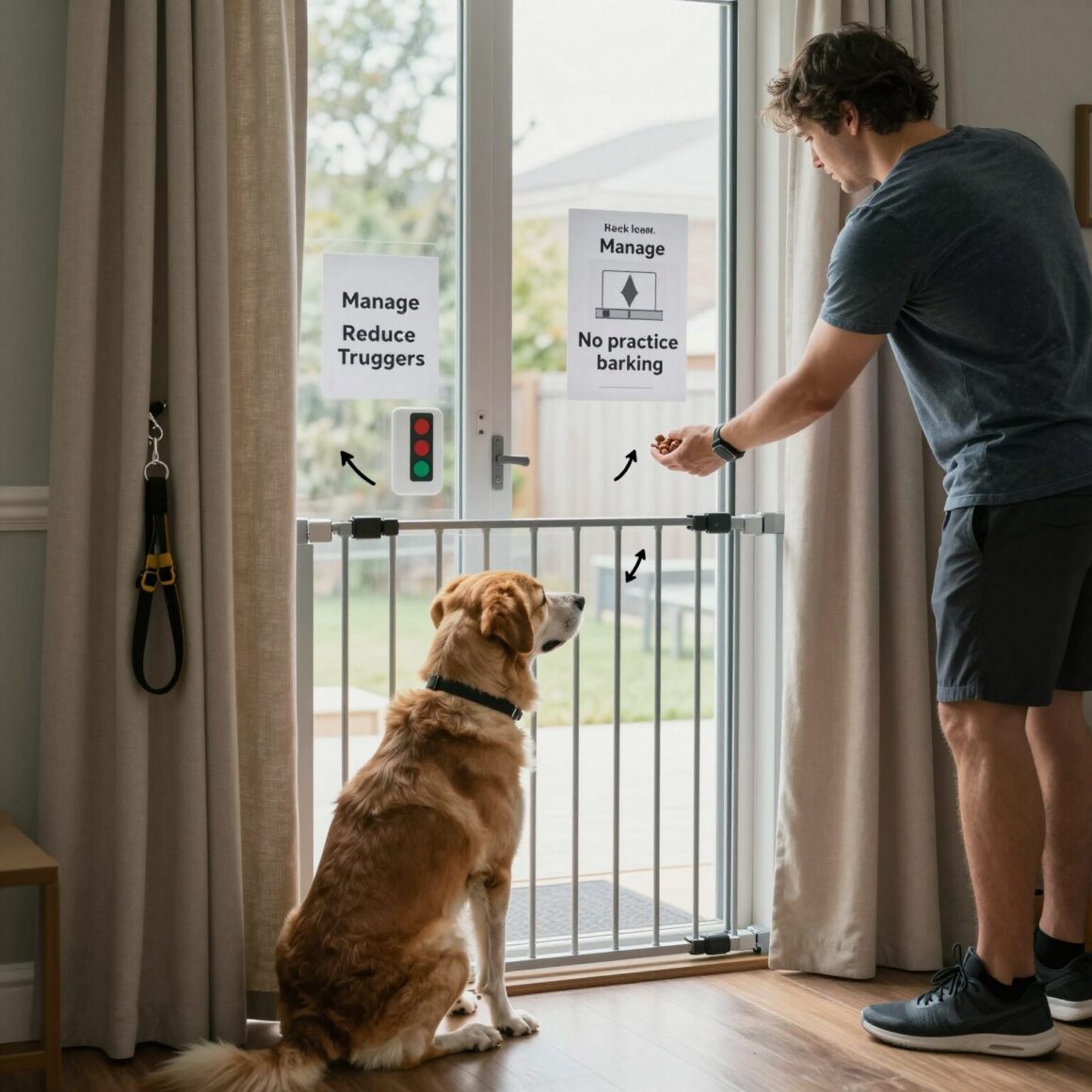
Here’s a truth that helped me a lot: if your dog keeps rehearsing barking, training goes slower. So before you train, you manage.
Management options I use:
- Block sightlines: Close curtains, use window film, or place a barrier so your dog can’t watch every passing person.
- Create a calm “safe zone”: Use a baby gate so your dog can relax without guarding the door.
- Move your dog away from triggers: If barking happens at the window, set up a different spot in the living room.
- Use a leash indoors during the transition period: This sounds weird, but it helps me prevent “run-in and bark” moments and lets me redirect quickly.
- Add enrichment during trigger times: A puzzle feeder, a long-lasting chew, or sniffing mat during door-knocking times can lower arousal.
Goal of management: reduce opportunities to bark while you teach what to do instead.
Step 3: Reward the Quiet Moments (Catch the Behavior You Want)

One of the most effective things I do is reward silence and calm—even briefly. Dogs learn faster when they’re rewarded for the behavior you want.
Try this:
- Wait for a moment your dog is quiet (even 1–2 seconds).
- Immediately reward with treats (and praise in a calm voice).
- Repeat several times.
It feels simple, but it works because your dog starts to realize: “Quiet earns good things.”
If your dog only goes quiet briefly, that’s okay. Start small. You can gradually raise the “quiet time” you reward.
Add the cue “Quiet”
Once you’ve caught some calm moments consistently:
- Choose a cue word: “Quiet” (or “Hush” if you prefer).
- The moment barking stops (or before it starts, when you can interrupt calmly), say the cue once, then reward silence.
Important: I don’t keep repeating “quiet” over and over. That usually turns the cue into more noise. One cue. Then reward quiet.
Step 4: Teach a Replacement Behavior (“Go to Place” or “Settle”)

If you only say “stop barking,” your dog may not know what to do instead. I always teach a replacement.
Two good options:
Option A: “Go to Place” (my favorite for door/window barking)
- Pick a spot: a bed or mat (near you, not directly at the window if possible).
- Toss a treat onto the mat and encourage your dog to step on it.
- When your dog is on the mat, reward again.
- Add the cue “Place” as your dog goes onto it.
Practice without distractions first. Then practice when the trigger appears, but start at an easier level than “real life.”
Option B: “Settle” (for general excitement)
- Reward lying down quietly.
- Practice “down + settle” in calm moments.
- Increase duration slowly.
What it looks like in real life
When a person approaches the door, you guide your dog to the mat, reward calm settling, and let barking have less “air time.” Your dog learns the job is settle, not sound the alarm nonstop.
Step 5: Train by Levels (Desensitize and Counter-Condition)
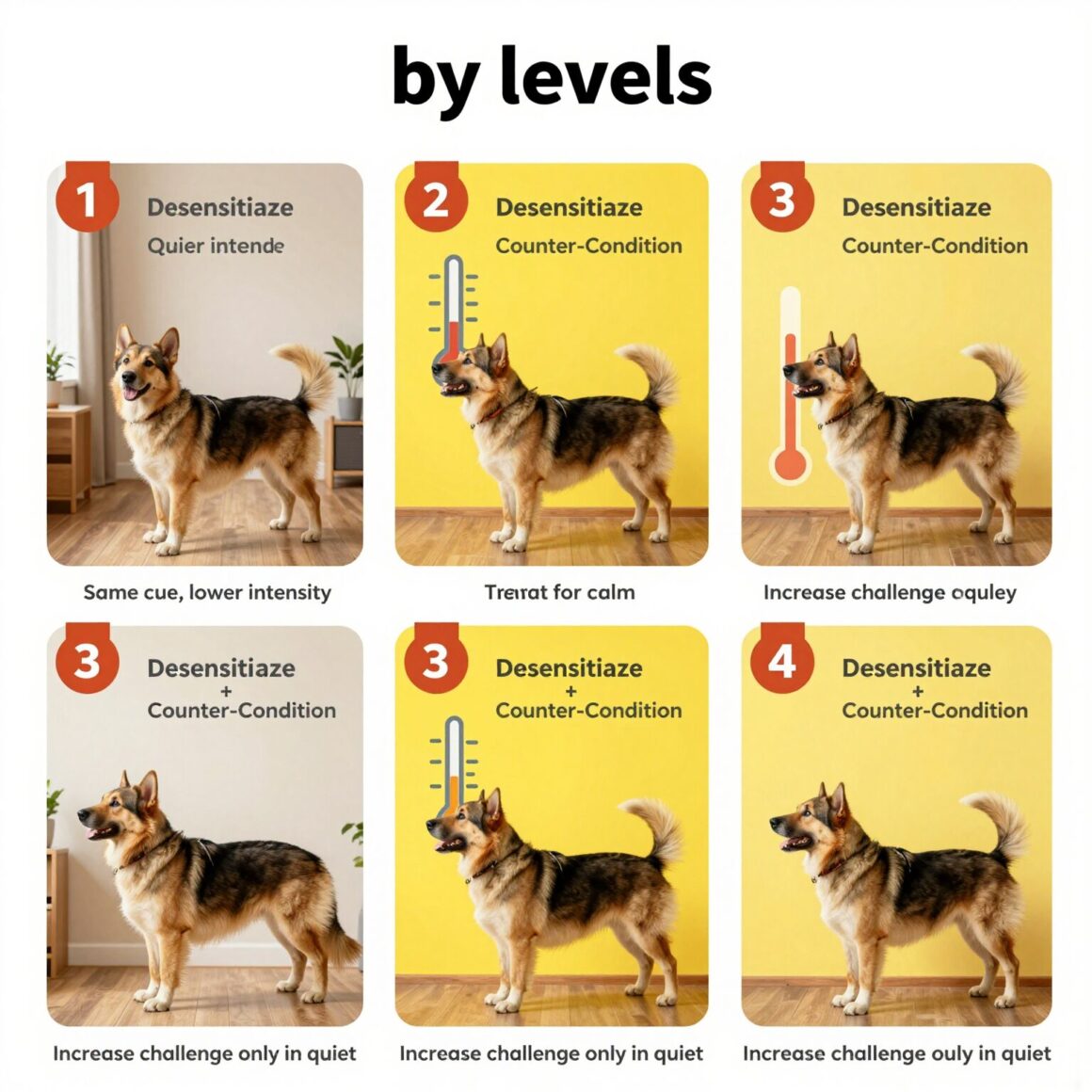
This is where results get real. Most people fail by going too hard too soon—like letting their dog bark at every trigger every day and then expecting sudden change.
Instead, I train in levels:
- Make the trigger less intense (from far away, lower volume, blocked view, or using a recording at low sound).
- Notice your dog’s threshold (the point where they start barking).
- Train just below that point so your dog can succeed.
- Reward calm/quiet + replacement behavior.
- Slowly increase difficulty over days/weeks.
Examples you can try:
- Doorbell/knocking barking: Start with a recording of the doorbell far away while your dog is on leash or in their safe zone. Reward quiet and mat behavior.
- Window barking: Start outside “practice” with a slow-moving person at a distance. Reward when your dog stays calm.
- Neighbor/dog barking: Start with less visual contact (turn body away slightly, more distance, barriers). Reward calm attention and “place.”
Counter-conditioning means you’re pairing the trigger with something good:
- Trigger happens → your dog looks to you calmly → you reward.
Over time, the trigger becomes “predictable and good,” not “panic and chaos.”
Step 6: Handle Demand Barking (Stop Reinforcing It)
If your dog barks to get attention, food, or to go out, you need to change the pattern. Demand barking often continues because barking “works.”
What I do:
- Don’t give the reward your dog wants during barking. That may mean delaying attention until your dog is quiet.
- If your dog wants outside: wait for a quiet moment, then open the door briefly.
- If your dog wants play: only start play after your dog is calm.
This can feel slow, but consistency matters. Dogs learn that calm behavior gets results. You’re not ignoring them forever—you’re teaching them how to communicate.
Add a polite request
Teach an alternative like:
- Ring a bell (trained)
- Bring a toy
- Go to mat and wait
Then reward that behavior every time.
Step 7: Reduce Separation Anxiety Barking (Change the “Leave” Story)
If your dog barks mainly when you leave, treat it as emotional work, not just “bad manners.”
Signs it might be separation-related:
- Barking starts right when you get ready to leave
- Your dog paces, drools, scratches, or seems frantic
- Barking continues until you return
Helpful changes:
- Practice short departures (seconds to minutes at first). Return before your dog escalates.
- Ignore the goodbye routine: Keep it boring. No long hugs or dramatic “see you soon.”
- Give a treat-dispensing chew right before you leave (so the leave becomes associated with something good).
- Use a camera if you can. Watching helps you see whether your dog is barking, how long it takes to start, and whether it escalates.
If the barking is intense, you may also consider a vet check for anxiety and, if needed, professional training support. It’s not a “just train harder” situation for some dogs.
Step 8: Prevent Excited, Untrained Barking (Exercise + Calm Skills)
A lot of barking comes from excess energy or poor coping skills. If your dog is under-exercised or under-stimulated, training will be harder.
I build a daily mix:
- Short walks with sniffing (sniffing counts as mental work)
- Training games (sit, look at me, place)
- Chews (safe, long-lasting options)
- Puzzle feeders (slow down eating = more calm)
- Calm time (structured relaxation, not “free-for-all lounging”)
Even 15–30 minutes of good mental work can lower barking. Also, I make sure the dog isn’t sleeping too much and then barking at night because they’re overstimulated. Timing matters.
Tips
- Use a calm voice. Yelling often adds excitement, and your dog may join in.
- Reward faster than you think. Timing is everything—reward within a second of quiet/calm.
- Keep training sessions short (2–5 minutes), especially at the start.
- Don’t train only when things are already out of control. Train earlier, when your dog is more capable.
- Track patterns for a week. You’ll usually see a clear trigger you can manage.
- Check your dog’s needs: hunger, pain, overstimulation, or sudden changes can cause new barking.
- If barking is sudden and unusual, consider a vet visit to rule out discomfort or hearing changes.
FAQ
Why does my dog bark at nothing?
Sometimes it’s not “nothing.” Dogs may hear high sounds humans can’t, notice movement outside, or bark out of alert curiosity. Check windows, doors, and outdoor sounds. If it’s mostly indoors, try managing distractions and teaching “go to place + settle.”
Should I punish my dog for barking?
I usually don’t recommend punishment for barking. It can increase stress and make barking worse (especially for fear/anxiety). Instead, I focus on management and teaching a calm alternative that gets rewarded.
How long will it take to stop barking?
It depends on the cause and how consistent you are. Many people see improvement in 1–3 weeks with daily practice, while deeper issues (like separation anxiety) can take 6–12 weeks or more. The key is progress, not perfection.
What if my dog barks nonstop even during training?
That could mean the trigger is too strong, your dog is over threshold, or the management isn’t enough yet. Go back a step: increase distance, block more sight, lower intensity, and reward smaller successes. Also consider vet or trainer support if the behavior seems panic-driven.
Can anti-bark collars help?
Some devices stop barking mechanically, but they can also create stress or fear. I recommend using behavior training and management first. If you’re considering a collar, talk to a qualified trainer or veterinarian to choose the safest option and ensure it doesn’t worsen anxiety.
My dog barks only when I’m on calls. What should I do?
Try combining management (block the view, move to a “place” spot) with a routine. Give a chew or puzzle before your calls and practice “place + settle” during low-distraction times. If your dog barks while you’re busy, calmly return them to their spot and reward silence.
Conclusion
If you want to stop dog barking, the goal isn’t to silence your dog forever—it’s to teach them what to do instead. I start by figuring out the real trigger, then I manage the environment so barking isn’t being practiced all day. After that, I reward quiet moments, teach a replacement like “place” or “settle,” and train in small levels so your dog can succeed. With consistency and the right plan, you’ll usually see quieter, calmer behavior sooner than you expect. Pick one trigger to focus on this week, run the steps, and watch your dog learn a new routine—one calm moment at a time.

Samuel Michael
I've have been involved in Backyard Farm for over 15 years, especially livestock and market gardening. I blog at my free Time and ive My most helpful thoughts on this blog.


