

Last updated: March 11, 2026
Quick Answer
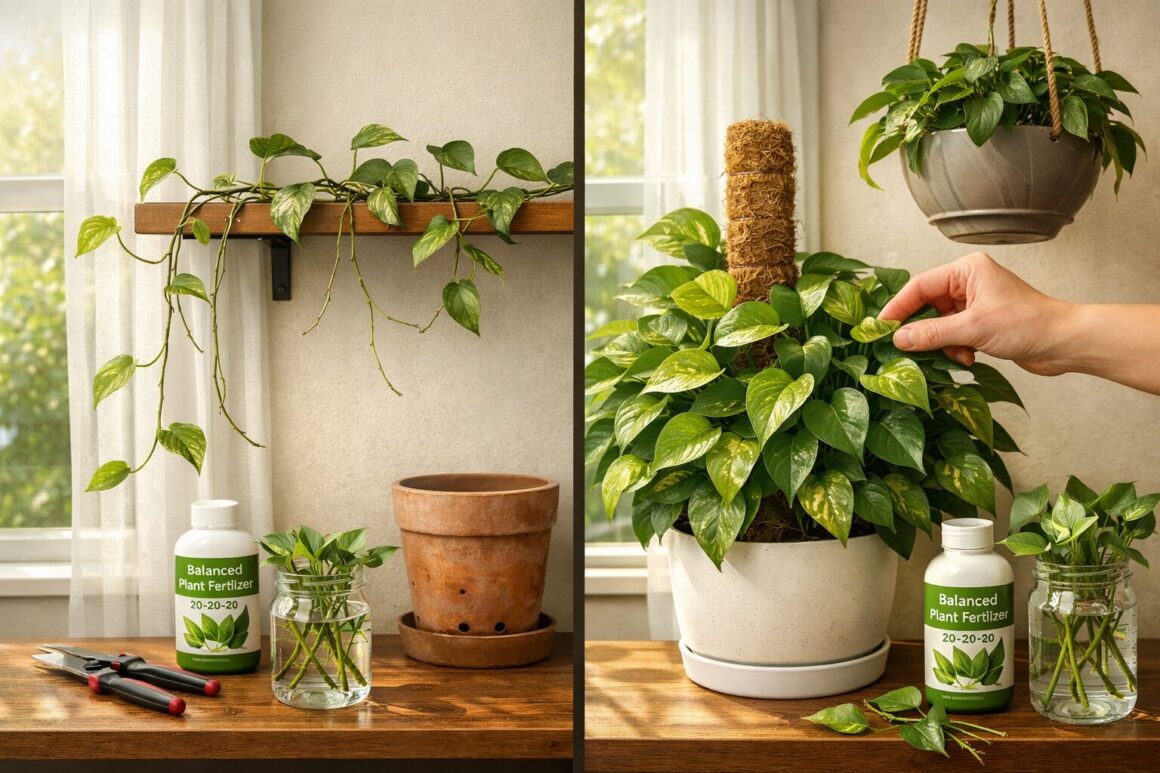
The fastest way to stop a pothos from getting leggy is to give it brighter indirect light, prune vines back to a node, and propagate cuttings back into the same pot. If you’re searching for 8 ways to stop leggy pothos, the goal is simple: reduce stretched growth and encourage more leaves to form closer together.
Key Takeaways
- Low light is the most common cause of a leggy pothos.
- Pruning above a node helps pothos branch and fill out.
- Propagating cuttings back into the pot is the quickest way to make a sparse plant look fuller.
- Rotating the plant helps stop one-sided, stretched growth.
- A support pole or trellis can encourage larger, healthier leaves.
- Watering well but not too often keeps growth steady and reduces stress.
- A light feeding during active growth can support fuller foliage.
- Old bare vines rarely refill on their own, so pruning is usually better than waiting.
What does a leggy pothos look like?
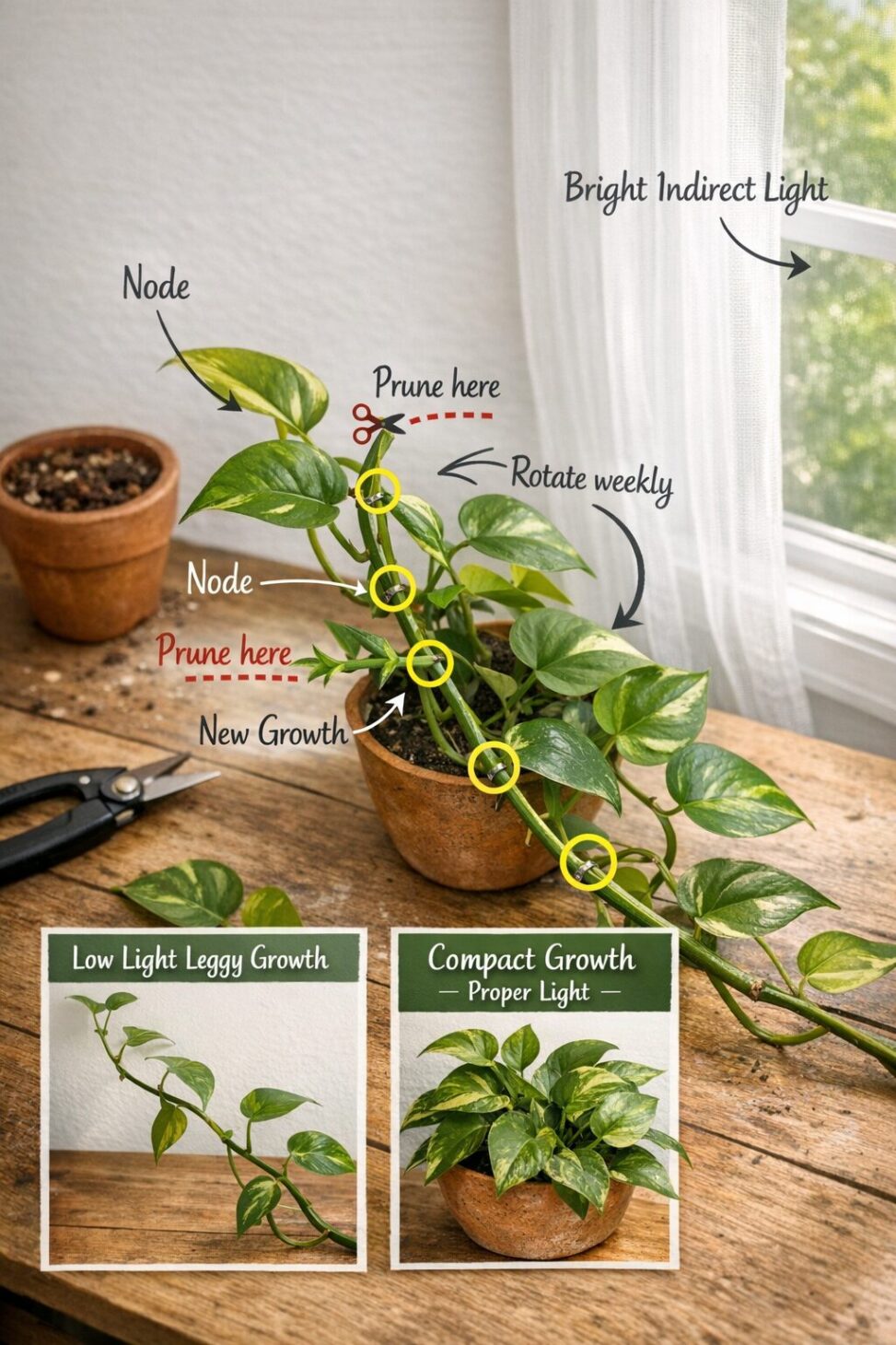
A leggy pothos has long stems with wide gaps between leaves, smaller new leaves, and bare sections of vine. Legginess usually means the plant is stretching for light or growing unevenly because of weak growing conditions.
Common signs include:
- Long vines with few leaves
- Leaves only at the tips
- Smaller new leaves than older ones
- Growth leaning hard toward a window
- Thin, weak stems that don’t look full
A pothos can survive in low light, but survival and attractive growth are not the same thing.
If your plant still looks green but sparse, that’s a clue. A healthy pothos should look full, leafy, and compact enough that the vines don’t appear bare for long stretches.
Why does pothos get leggy in the first place?
Pothos gets leggy mainly because it does not get enough light. Other causes include lack of pruning, uneven light from one side, tired potting mix, and weak growth during cooler or darker months.
Here are the main reasons:
Too little light
This is the biggest one. In dim rooms, pothos stretches to find more light.No pruning
If you never cut vines back, the plant keeps extending longer instead of branching.One-direction light
A pothos near a window can grow toward one side and leave the back thin.Overcrowded or poor soil
Roots in compacted, old mix may not support strong leaf growth.Inconsistent care
Big swings in watering, temperature, or feeding can slow healthy growth.
Choose light as your first fix if the leaves are small and the spaces between them are getting longer.
Choose pruning first if the plant has healthy vines but too many bare sections.
What are the 8 ways to stop leggy pothos?
The 8 ways to stop leggy pothos are practical and work best together. Start with light and pruning, then improve the setup so new growth stays full instead of stretching again.
1. Move pothos to brighter indirect light
Brighter indirect light is the most effective fix for a leggy pothos. A pothos grows fuller when it gets enough light to make compact, leafy growth instead of reaching.
Best placement:
- Near an east-facing window
- A few feet back from a south- or west-facing window with a sheer curtain
- Under a grow light if your room is naturally dark
Avoid:
- Harsh midday sun on tender leaves
- Deep corners far from windows
A quick rule I use: if you can comfortably read near the plant during the day without turning on a lamp, the spot may work. If the room feels gloomy most of the day, the pothos will probably stretch.
Common mistake: Moving a low-light pothos straight into hot direct sun. That can scorch leaves. Shift it gradually over several days.
2. Prune vines back above a node
Pruning is the second most important step in 8 ways to stop leggy pothos because it pushes the plant to produce new growth from lower points. Cut just above a node, which is the small bump where leaves and roots can grow.
How to prune:
- Find a bare or extra-long vine
- Locate a node below healthy leaves
- Use clean scissors or pruners
- Cut just above the node
- Save the cutting for propagation
Good times to prune:
- Spring and summer, when growth is strongest
- Any time the plant is actively growing indoors
Don’t be afraid to cut more than one vine. A light trim may help, but a really sparse pothos often looks better after a more decisive haircut.
3. Propagate cuttings and plant them back into the pot
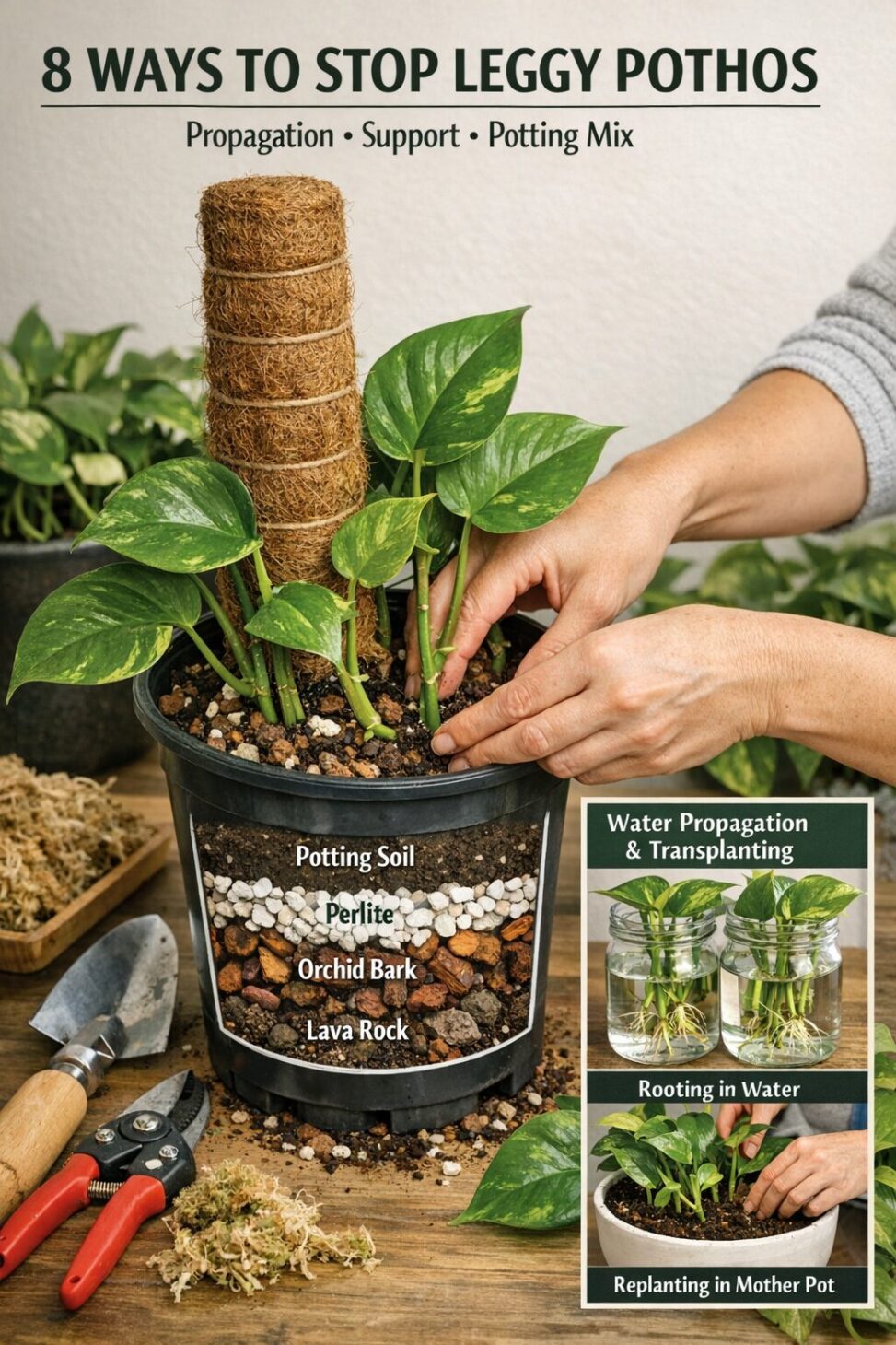
If you want a fuller pothos fast, propagate healthy cuttings and tuck them back into the same pot. This does not reverse old bare vines, but it does add more stems so the plant looks dense again.
Simple propagation steps:
- Cut a vine with 2 to 4 nodes
- Remove the lowest leaf
- Root the cutting in water or moist potting mix
- Wait until roots are established
- Plant several cuttings back around the base
Why this works:
- More stems in one pot create a bushier look
- New rooted cuttings fill empty spaces
- You keep the same plant instead of replacing it
Choose water propagation if you want to watch root growth.
Choose direct-to-soil propagation if you want fewer transplant steps.
4. Rotate the plant regularly
Rotating a pothos helps keep growth even because all sides get light over time. A plant that faces one direction for months often gets full on one side and sparse on the other.
A simple routine:
- Turn the pot about a quarter turn every week or two
- Check whether vines are all leaning the same way
- Adjust placement if one side still looks weak
This step is easy to ignore, but it matters. Even a healthy pothos can look leggy from one angle if the back side never gets enough light.
How do watering and feeding affect leggy pothos?
Watering and feeding do not usually cause legginess by themselves, but they can make weak growth worse. Pothos needs steady care to support fuller leaves and healthy new stems.
5. Water when the top inch or two feels dry
A pothos grows best when the soil partly dries between waterings. Constantly soggy soil can stress roots, while severe dryness can slow growth and shrink leaves.
Use this watering check:
- Put a finger into the top 1 to 2 inches of soil
- If that layer feels dry, water thoroughly
- Let excess water drain out
- Empty saucers or cachepots so roots do not sit in water
Signs your watering may be off:
- Yellow leaves and limp stems from overwatering
- Crispy leaves and stalled growth from underwatering
Edge case: In winter, pothos usually needs less water because growth slows and indoor light is weaker.
6. Feed lightly during active growth
A small amount of fertilizer can help pothos make healthier leaves during spring and summer. Fertilizer will not fix a leggy plant on its own, but it supports recovery after pruning and repotting.
Use a balanced houseplant fertilizer:
- Follow the label at a diluted rate if needed
- Feed during active growth
- Skip feeding if the plant is stressed, newly repotted, or sitting in very low light
Common mistake: Adding more fertilizer to compensate for poor light. Extra feeding cannot replace sunlight or a grow light.
Should you repot or add support to fix a leggy pothos?
Repotting and support can help, but only when they match the real problem. Repot if roots are crowded or soil is worn out. Add support if you want stronger climbing growth and larger leaves.
7. Refresh the soil or repot if roots are cramped
A rootbound pothos or one stuck in dense old soil may struggle to grow well. Fresh mix helps with drainage, air flow, and more even moisture.
Signs it may be time:
- Roots circling the pot
- Water running straight through too fast
- Soil that stays soggy for too long
- Stalled growth despite good light
A good pothos mix is light and airy. Many growers use regular potting mix with extra perlite and orchid bark.
| Problem | Best fix | Why it helps |
|---|---|---|
| Low light | Move to brighter indirect light | Reduces stretching |
| Bare vines | Prune and propagate | Adds branching and fullness |
| One-sided growth | Rotate plant | Evens out light exposure |
| Rootbound plant | Repot | Supports stronger growth |
8. Give the vines something to climb
A pothos often grows stronger leaves when it climbs. A moss pole, coir pole, trellis, or even small wall support can encourage more vigorous upward growth than hanging vines alone.
Support options:
- Moss pole for aerial root contact
- Coir pole for simple structure
- Small trellis for compact spaces
- Clips for training on a wall or board
Choose a moss pole if you want the best chance at larger leaves.
Choose a trellis if you want shape and support without keeping a pole moist.
8 ways to stop leggy pothos: the best recovery plan
If you want the shortest path to a fuller plant, combine the most effective fixes. The 8 ways to stop leggy pothos work better as a system than as one-off tips.
Quick checklist
- Move the plant to brighter indirect light
- Prune long vines above nodes
- Root cuttings and plant them back in the pot
- Rotate weekly or every two weeks
- Water when the top inch or two is dry
- Feed lightly in active growth
- Repot if roots are crowded or soil is old
- Add a pole or trellis for support
What to expect
- Within a few weeks: Better direction of growth after improved light
- After pruning: New shoots may start from nodes during active growth
- After propagation: The pot looks fuller once rooted cuttings are planted back
Old naked sections usually do not suddenly refill with leaves. If a vine is very bare, pruning and replacing that space with propagated cuttings is usually the cleaner fix.
Common mistakes when trying to fix a leggy pothos
Most failed fixes come from solving the wrong problem. If the plant stays in low light, no amount of fertilizer, repotting, or wishful thinking will make it dense.
Watch out for these mistakes:
- Keeping the plant too far from a window
- Trimming only the tips and never cutting back enough
- Overwatering after moving to lower winter light
- Fertilizing a stressed or weak-rooted plant
- Expecting old bare vines to fill in evenly
- Putting rooted cuttings in a separate pot instead of thickening the original one
FAQ
Can a leggy pothos become full again?
Yes, a leggy pothos can look full again with brighter light, pruning, and adding propagated cuttings back into the same pot.
Will bare pothos vines grow new leaves?
Usually, old bare sections do not refill well. New growth is more likely near active nodes after pruning.
How often should I prune pothos?
Prune pothos whenever vines become too long or sparse, especially during active growth in spring and summer.
Is leggy pothos caused by overwatering?
Not usually. Low light is the most common cause, but overwatering can weaken roots and slow healthy growth.
Where should I cut a pothos vine?
Cut just above a node on the mother plant. For propagation, make sure each cutting includes at least one node.
Do pothos like direct sun?
Pothos prefers bright indirect light. Harsh direct sun can burn leaves, especially after the plant has lived in low light.
Should I use a moss pole for pothos?
Use a moss pole if you want climbing growth and potentially larger leaves. It helps more with growth habit than with basic fullness alone.
How long does it take to fix a leggy pothos?
You may see better growth direction in a few weeks, but a truly fuller look often takes longer and usually involves pruning plus propagation.
Conclusion
If your pothos looks stretched, sparse, or thin, start with the basics that actually change growth: more bright indirect light, a real pruning session, and propagation back into the pot. Those three steps do the heavy lifting.
My simple next-step plan is this:
- Move the plant closer to good light today
- Prune the longest bare vines this week
- Root the cuttings and replant them for fullness
- Rotate and maintain steady care going forward
That’s the practical answer to 8 ways to stop leggy pothos. You do not need to throw the plant away. In most cases, you just need to help it grow in a way that matches how pothos naturally thrives.
Sources
No external sources were directly cited.
Meta title and meta description
pothos, leggy pothos, 8 ways to stop leggy pothos, pothos care, pruning pothos, pothos propagation, indoor plants, houseplant care, bright indirect light, moss pole, repotting pothos

Samuel Michael
I've have been involved in Backyard Farm for over 15 years, especially livestock and market gardening. I blog at my free Time and ive My most helpful thoughts on this blog.

